


Views: 222 Author: CNDY-Press Publish Time: 2026-06-09 Origin: Site


Content Menu
● Understanding Integrated Pipe Sheet Laser Systems
● What We Mean by Standalone Fiber Laser Cutting Machines
● Space-Saving vs. Throughput: The Core Trade-Off
● Space and Layout: Where Integrated Systems Shine
● Throughput and Utilization: Where Standalone Machines Win
● Changeover, Nesting, and Job Mix
● Cost and Investment Strategy
● Fiber Laser Performance for Sheet and Tube
● Practical Evaluation Checklist (Step-by-Step)
● CNDY‑Press Perspective: How We Guide OEM and ODM Clients
● Call to Action: Discuss Your Layout and Throughput Targets with Our Engineers
● FAQ
Integrated Pipe Sheet Laser vs. Standalone Machines: Space-Saving vs. Throughput is not a theoretical question for us at CNDY‑Press—it is a choice we face with customers almost every week when they ask whether to buy a combined tube and sheet fiber laser cutting machine or separate, standalone fiber laser cutting machines for sheet and pipe. From an engineering and operations perspective, both approaches can be right; the key is matching your factory constraints, product mix, and growth roadmap to the right configuration. [durmapress]
An Integrated Pipe Sheet Laser (sometimes called a tube and sheet fiber laser cutting center) combines a flatbed table for sheet cutting with a rotary axis or chuck system for tube and pipe processing on a single machine. The same fiber laser source, optics, and CNC control handle both flat parts and tubes, often with dedicated software modules for each. [haldencn]
In practice, this means:
- One machine footprint for two major processes: sheet and tube cutting. [durmapress]
- Shared automation options such as loading/unloading systems and fume extraction. [piranhafab]
- A single operator and programming environment for both product families. [haldencn]
For OEM and ODM projects, this "all‑in‑one" approach can be extremely attractive, especially in the early stages of building a flexible metal fabrication cell. [gwklaser]
By contrast, a standalone configuration uses separate machines for different tasks—for example: [gwklaser]
- One flatbed fiber laser cutting machine dedicated to sheet and plate. [durmapress]
- One tube or pipe laser cutting machine dedicated to round, square, and rectangular profiles. [mac-tech]
Each machine has its own working envelope, automation options, and possibly its own operator. This approach is common in medium‑to‑large fabrication plants where throughput, redundancy, and specialized productivity are top priorities. [mac-tech]
From a layout and operations standpoint, the headline trade‑off is straightforward:
- Integrated Pipe Sheet Laser – Maximizes space‑saving and flexibility in a single footprint. [haldencn]
- Standalone Machines – Maximizes throughput, specialization, and parallel processing. [piranhafab]
However, the real decision is more nuanced when you consider machine utilization, changeover, workforce skill levels, and future expansion.
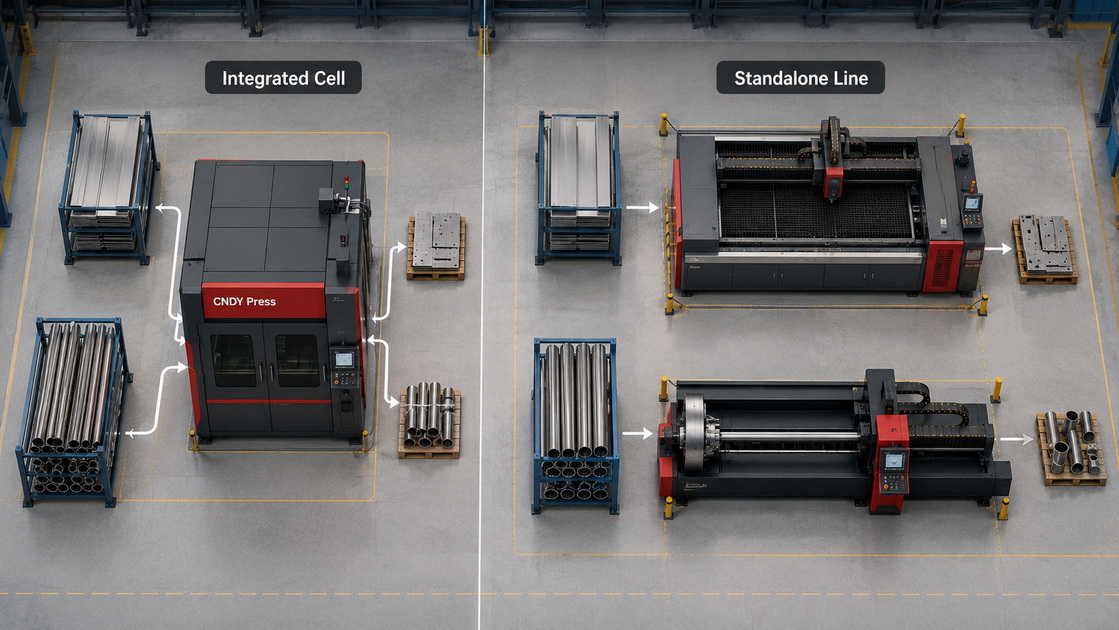
One of the strongest arguments for an integrated pipe and sheet fiber laser is limited floor space. Many small and mid‑size fabrication shops simply do not have room for multiple large machines, raw material storage, and finished goods staging. [bescutter]
Integrated Pipe Sheet Laser advantages for space:
- Single machine footprint instead of two. [bescutter]
- Shorter walking and material handling distances for operators. [durmapress]
- Easier to enclose and manage with one set of safety guarding and fume extraction. [wisecutlaser]
In my experience, this is often the turning point for urban workshops, contract manufacturers in high‑rent zones, or plants adding laser capacity into an already crowded layout. [wisecutlaser]
| Factor | Integrated Pipe Sheet Laser | Standalone Machines |
|---|---|---|
| Floor Space Requirement | One combined footprint (smaller overall) (bescutter) | Two separate footprints, larger total area (mac-tech) |
| Safety Enclosure | Single enclosure and fume system (bescutter) | Separate enclosures and extraction per machine (wisecutlaser) |
| Material Flow Complexity | Simplified, one main cell (durmapress) | More complex, multiple cells (mac-tech) |

On the other side, standalone fiber laser cutting machines generally offer higher aggregate throughput because you can run sheet and tube jobs in parallel instead of queueing them on one machine. [mac-tech]
Key advantages:
- Parallel processing – Tube cutting and sheet cutting happen at the same time on different machines. [piranhafab]
- Specialized optimization – Tube machines are optimized for rotary motion and clamping, while flatbed machines are optimized for sheet nesting and shuttle tables. [gwklaser]
- Better uptime – If one machine is down for maintenance, the other can continue running. [piranhafab]
For manufacturers dealing with high volume and repeatable part families, especially in automotive, HVAC, and structural steel, separate systems are often the only way to keep up with demand without adding extra shifts. [mac-tech]

In real life, the "space‑saving vs. throughput" debate quickly turns into a job mix and scheduling discussion.
Integrated Pipe Sheet Laser realities:
- If you frequently switch between short tube batches and short sheet batches, an integrated machine can actually simplify scheduling, because everything passes through one cell.
- But if you need to run long sheet nesting programs and long tube cutting programs, you will create internal queueing—one type of work waits while the other runs.
Standalone system realities:
- You can assign dedicated shifts or time windows to each machine for long‑running programs.
- Programmers can independently optimize sheet nests for material yield and tube nests for cycle time without worrying about mixed schedules. [gwklaser]
For OEM and ODM work where product mix can change unpredictably, I often recommend starting with an integrated system, then adding a dedicated tube or sheet machine once the main revenue streams stabilize.
From a pure purchase price perspective, an integrated pipe sheet laser is often more affordable than buying two separate high‑quality machines, especially when you consider duplicated automation and infrastructure. [haldencn]
However, total cost of ownership depends on:
- Expected throughput and utilization – Standalone systems may generate more billable hours in high‑volume environments. [mac-tech]
- Maintenance downtime – One integrated machine down means both sheet and tube capacity is offline; with standalone systems, you maintain partial capability. [piranhafab]
- Expansion path – Starting with an integrated system can be a lower‑risk entry point, with the option to add standalone machines later as volume grows. [haldencn]
From a financial planning perspective, many of our customers treat the integrated machine as an initial "core cell" investment, then evaluate a second standalone system once machine utilization exceeds 70–80% on average.
To make this decision more concrete, let's map typical use cases to each configuration. [gwklaser]
Integrated Pipe Sheet Laser is ideal when:
- You have limited floor space but need both sheet and tube capability. [bescutter]
- Your product mix is medium volume, high variety—many SKUs, moderate repeat orders. [mac-tech]
- You want to standardize on one programming environment and one operator team initially. [durmapress]
Standalone Sheet and Tube Lasers are ideal when:
- You run high‑volume, repeatable jobs with stable demand. [haldencn]
- You have available floor space and want true parallel processing. [piranhafab]
- You need redundancy and uptime for critical OEM contracts. [piranhafab]
Modern fiber laser cutting machines have reshaped expectations for both sheet and tube processing. High‑power fiber lasers (often 12 kW and above) can cut mild steel up to 60 mm and stainless steel or aluminum up to around 30 mm with excellent edge quality. [ipgphotonics]
Industry data shows that, for many common thicknesses: [ipgphotonics]
- Fiber lasers cut significantly faster than older technologies like CO₂ or plasma on thin to medium sheet. [ipgphotonics]
- Tube laser cutting systems deliver clean, precise cuts with minimal post‑processing, across steel, aluminum, and copper. [mac-tech]
In this context, the main question is not whether fiber laser is capable—it is how best to deploy that capability in your plant: integrated vs. standalone.
When I work with customers on this decision, we typically walk through a structured checklist. You can do the same internally:
1. Map your current and projected product mix.
- Percentage of sheet‑only, tube‑only, and mixed assemblies.
2. Audit your available floor space and utilities.
- Can you realistically fit two machines with buffer zones and material racks?
3. Estimate your required monthly throughput.
- Convert annual volume into required cutting hours for sheet and tube separately.
4. Assess your staffing and skill levels.
- Do you have (or can you hire) dedicated operators and programmers for multiple machines?
5. Define your risk tolerance for downtime.
- How critical is it to maintain at least partial cutting capacity during maintenance?
By answering these questions honestly, the right direction—Integrated Pipe Sheet Laser vs. Standalone Machines—usually becomes much clearer.

As a manufacturer of fiber laser cutting machines and complete sheet metal processing lines, CNDY‑Press often joins projects early, when the plant layout, part families, and automation roadmap are still fluid. In OEM and ODM environments, we typically:
- Analyze annual part lists and material structures to estimate sheet vs. tube load.
- Propose either a compact integrated pipe sheet laser cell or a two‑machine configuration with shared automation.
- Factor in future needs like robotic loading, pallet systems, and downstream bending or welding cells so you do not outgrow your first investment too quickly.
Our goal is not to push one configuration over the other, but to align machine selection with your long‑term business model and space constraints.
If you are currently debating Integrated Pipe Sheet Laser vs. Standalone Machines, the fastest way to get clarity is to run the numbers on your real parts, not generic catalogs.
1. Will an integrated pipe sheet laser be fast enough for mass production?
For small to medium volumes or mixed product portfolios, an integrated system is usually fast enough and far more space‑efficient, but high‑volume single‑part production often benefits from separate dedicated machines. [durmapress]
2. Can I start with an integrated machine and add standalone systems later?
Yes. Many manufacturers start with an integrated pipe sheet laser to validate markets and workflows, then add a standalone sheet or tube laser once demand and part mix stabilize. [gwklaser]
3. Do integrated machines compromise cutting quality compared to standalone machines?
No. When built on modern fiber laser platforms with proper motion systems and optics, integrated and standalone systems can deliver comparable cut quality; the main differences are layout, throughput, and utilization. [ipgphotonics]
4. Which option is better for automation and lights‑out operation?
Both can be automated, but standalone machines offer more flexibility for independent loading/unloading and can be easier to scale into multi‑shift lights‑out cells in very high‑volume environments. [haldencn]
5. How do I justify the investment to management?
Build a simple business case comparing integrated vs. standalone: include machine cost, floor space cost, estimated cutting hours, labor savings, and risk of downtime, then choose the configuration with the best payback period at your projected volumes. [gwklaser]
1. IPG Photonics. "Laser Cutting vs. Plasma Cutting: A Modern Guide."
<https://www.ipgphotonics.com/newsroom/stories/laser-cutting-vs-plasma-cutting-modern-guide> [ipgphotonics]
2. DurmaPress. "Laser Cutting Machine | DurmaPress Press Brake."
<https://www.durmapress.com/laser-cutting-machine/> [durmapress]
3. Halden. "Which Laser Machines Are Best for Cutting Sheet Metal?"
<https://haldencn.com/which-laser-machines-are-best-for-cutting-sheet-metal/> [haldencn]
4. HGG Group. "Laser Pipe Cutting Versus Plasma Pipe Cutting."
<https://www.hgg-group.com/knowledge/laser-pipe-cutting-versus-plasma-pipe-cutting/> [hgg-group]
5. Mac-Tech. "Tube Laser Cutting vs. Traditional Methods: A Comparative Study."
<https://mac-tech.com/metal-fab-equip/tube-laser-cutting-vs-traditional-methods-a-comparative-study/> [mac-tech]
6. Piranha. "CNC Fiber LASER Metal Cutting Machines."
<https://piranhafab.com/lasers/> [piranhafab]
7. GWK Laser. "How to Select the Right Tube Laser Cutting Machine."
<https://www.gwklaser.com/how-to-select-tube-laser-cutting-machine.html> [gwklaser]
8. BesCutter. "Space Saver Fiber Laser Cutting Machine."
<https://www.bescutter.com/collections/fiber-laser-cutting-machine/products/bescutter-space-saver-1500-4000w-5x10-fiber-laser-for> [bescutter]
9. Wisecut Laser. "Best Laser Cutter Options vs CNC for Precision Cutting."
<https://www.wisecutlaser.com/news/best-laser-cutter-options-vs-cnc-for-precision-cutting/> [wisecutlaser]


