


Views: 283 Author: CNDY-Press Publish Time: 2026-09-13 Origin: Site


Content Menu
● What Is the Difference Between Hybrid and Servo-Hydraulic Press Brakes?
● Hybrid vs Servo-Hydraulic Press Brake Comparison
● Where the Original Comparison Needs More Detail
● How Hybrid Press Brakes Work
>> Hybrid Press Brake Advantages
>> Hybrid Press Brake Limitations
● How Servo-Hydraulic Press Brakes Work
>> Servo-Hydraulic Press Brake Advantages
>> Servo-Hydraulic Press Brake Limitations
● Which Press Brake Is Better for Your Application?
>> Choose a Hybrid Press Brake for Precision and Repetitive Production
>> Choose a Servo-Hydraulic Press Brake for Power and Flexibility
● Accuracy: Machine Type Alone Does Not Guarantee Precision
● Energy Evaluation: Measure kWh Per Finished Part
● The Overlooked Sourcing Risk: "Hybrid" May Describe Different Designs
● Maintenance and Total Cost of Ownership
>> Hybrid Maintenance Priorities
>> Servo-Hydraulic Maintenance Priorities
● Compliance, Safety, and Export Readiness
● Why Consider CNDY-Press for Custom Press Brake Projects?
>> 1. Is a hybrid press brake the same as a servo-hydraulic press brake?
>> 2. Which machine type saves more energy?
>> 3. Is a servo-hydraulic press brake suitable for thick steel?
>> 4. Does a hybrid press brake require less maintenance?
>> 5. How should I compare energy consumption between suppliers?
Choosing between a hybrid press brake and a servo-hydraulic press brake should start with your actual bending workload—not with a broad promise of energy savings or machine speed. Hybrid systems can reduce idle energy use and heat generation in many light-to-medium-duty, high-cycle operations, while servo-hydraulic press brakes remain a practical choice for shops that need robust force, broad tonnage options, and dependable performance on mixed or heavy sheet-metal work.
For buyers evaluating a new CNC press brake, the decision influences energy consumption, cycle time, bend repeatability, maintenance planning, spare-parts requirements, operator training, and future automation potential. At CNDY-Press, we manufacture CNC press brakes and complete sheet-metal processing equipment, while supporting OEM, ODM, and customized-machine projects for applications including decorative furniture, aerospace, shipbuilding, automotive, steel metallurgy, engineering machinery, bridge construction, and petroleum industries.
This expert guide explains the difference between hybrid and servo-hydraulic press brakes, identifies the information gap in many manufacturer comparisons, and provides a practical selection framework for distributors, fabrication shops, industrial OEMs, and procurement managers.
Quick decision: Choose a hybrid press brake when your work is dominated by repetitive, light-to-medium sheet-metal jobs and you can document meaningful energy and cycle-time gains. Choose a servo-hydraulic press brake when heavy plates, long bends, wider application flexibility, service familiarity, and robust load capacity are the main priorities.
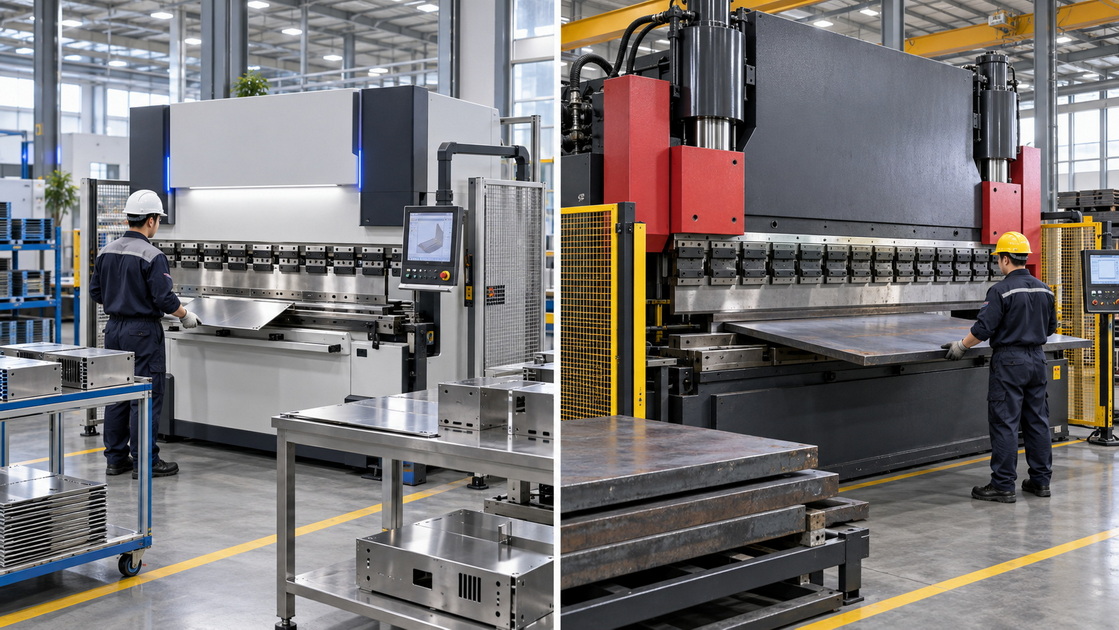
Both machine types use advanced control technology, but their energy architecture, motion behavior, and maintenance profile can differ.
A hybrid press brake generally combines an electric servo motor with a hydraulic system. Instead of keeping a conventional hydraulic pump running continuously at fixed speed, the system adjusts pump output through servo-motor control. The motor can supply energy when ram movement requires it and reduce output during lower-demand periods.
A servo-hydraulic press brake also uses a servo motor to drive the hydraulic pump and control ram movement. In commercial product naming, however, the terms "hybrid" and "servo-hydraulic" can overlap. Some manufacturers use "hybrid" for a variable-speed-pump system designed primarily for energy reduction, while others use "servo-hydraulic" for electronically synchronized hydraulic machines designed for a wider tonnage range.
This naming overlap is an important purchasing issue. Do not choose a machine based on its product label alone. Ask for a hydraulic schematic, motor-and-pump configuration, installed power, measured energy data, and maximum duty-cycle information.
The source article makes a useful high-level distinction: it describes hybrid press brakes as systems using servo motors to control hydraulic circuits only when required, while it presents servo-hydraulic models as robust, hydraulic-based machines that balance cost, power, and control for heavy manufacturing.
| Evaluation Factor | Hybrid Press Brake | Servo-Hydraulic Press Brake |
|---|---|---|
| Primary Architecture | Servo motor controls hydraulic pump output according to demand | Servo motor drives a hydraulic pump and controls hydraulic ram movement |
| Best-Fit Workload | Repetitive, light-to-medium sheet-metal bending | Mixed production, medium-to-heavy bending, long parts, higher-force work |
| Energy Profile | Often lower energy consumption during idle time and variable cycles | More efficient than conventional constant-pump hydraulics; actual savings depend on system design |
| Heat Generation | Often lower because the motor/pump does not run at full output continuously | Can be managed effectively, but hydraulic heat remains an important maintenance variable |
| Noise | Often lower during idle or light workloads | Usually lower than conventional hydraulic systems, but depends on pump, enclosure, and duty cycle |
| Cycle Response | Often responsive for short, repetitive programs | Strong and stable for heavier bends; speed depends on the specific machine configuration |
| Tonnage Range | Commonly suited to light and medium bending, though capabilities vary | Often preferred for broad or high-tonnage applications |
| Maintenance Focus | Electronics, servo drive, pump, sensors, hydraulic cleanliness | Hydraulic oil, valves, pumps, seals, cooling, servo drive, and synchronization |
| Technician Requirement | Requires technicians comfortable with servo and control diagnostics | Familiar hydraulic-service skills remain important, plus CNC and servo knowledge |
| Capital Cost | May be higher depending on the powertrain and controller package | Often competitive for heavy-duty configurations |
| Best Buyer Question | Can documented energy savings offset the added purchase cost in my cycle profile? | Can the machine reliably handle my heaviest parts while maintaining accuracy and reasonable operating cost? |
The right comparison is not "new technology versus old technology." Both configurations can use modern CNC controls, synchronized cylinders, crowning, multi-axis backgauges, safety systems, and Industry 4.0 features. The decision is about matching the powertrain to the production environment.
The existing article provides a clear overview of working principles, use cases, and maintenance differences. It correctly points buyers toward hybrid machines for precision thin-sheet work and servo-hydraulic systems for heavy structural applications.
However, a procurement-ready decision requires more than those broad categories.
Three missing considerations are especially important:
1. Measured energy per part—not marketing percentages. A supplier may claim energy savings, but a meaningful comparison requires the same part, material, bend sequence, cycle time, idle time, and machine configuration.
2. Tooling and production mix. A machine's operating cost is influenced by tool changes, programming time, material handling, scrap, and setup time—not only the hydraulic power unit.
3. Service capability in the buyer's region. A hybrid system may use more sophisticated servo electronics. If replacement drives, diagnostic support, or trained technicians are not available locally, apparent energy savings can be outweighed by downtime.
A published experimental study comparing conventional valve-controlled and servo-motor variable-speed-pump control in a press brake system reported up to 54% energy savings across 100 cycles for the variable-speed approach. That result supports the principle that demand-controlled hydraulic power can reduce energy use, but it should not be treated as a universal savings guarantee for every shop, tonnage, or work cycle.
A hybrid press brake typically uses a servo motor to drive a variable-speed hydraulic pump. The system adjusts pump speed according to the demand for flow and pressure.
During a bend cycle, the machine needs different levels of energy:
- Rapid approach requires flow and controlled movement.
- Bending requires pressure and accurate synchronization.
- Return requires controlled motion.
- Idle time should require minimal energy.
A conventional fixed-speed hydraulic system may keep the motor running even when the machine is not actively bending. A hybrid system can reduce energy draw when demand is lower.
- Potentially lower electricity consumption in intermittent or high-cycle production.
- Lower idle power draw compared with fixed-speed hydraulic systems.
- Reduced heat generation in some operating conditions.
- Potentially quieter operation.
- Responsive ram movement and controlled acceleration.
- Suitable for short-run repeat work, thin sheet, and precision components.
- Can support improved operator comfort in enclosed or noise-sensitive workshops.
- Energy savings depend on utilization, not just the machine label.
- Upfront cost may be higher than a conventional hydraulic configuration.
- Servo drives and control components may require more specialized diagnostic skills.
- The machine may not be the preferred option for every high-tonnage application.
- Hydraulic components still exist, so oil cleanliness and seal maintenance remain relevant.
A hybrid press brake is not "maintenance-free." It simply changes the maintenance profile. Buyers should still monitor oil condition, filters, hoses, pressure stability, cooling, electrical connections, encoder health, and software parameters.
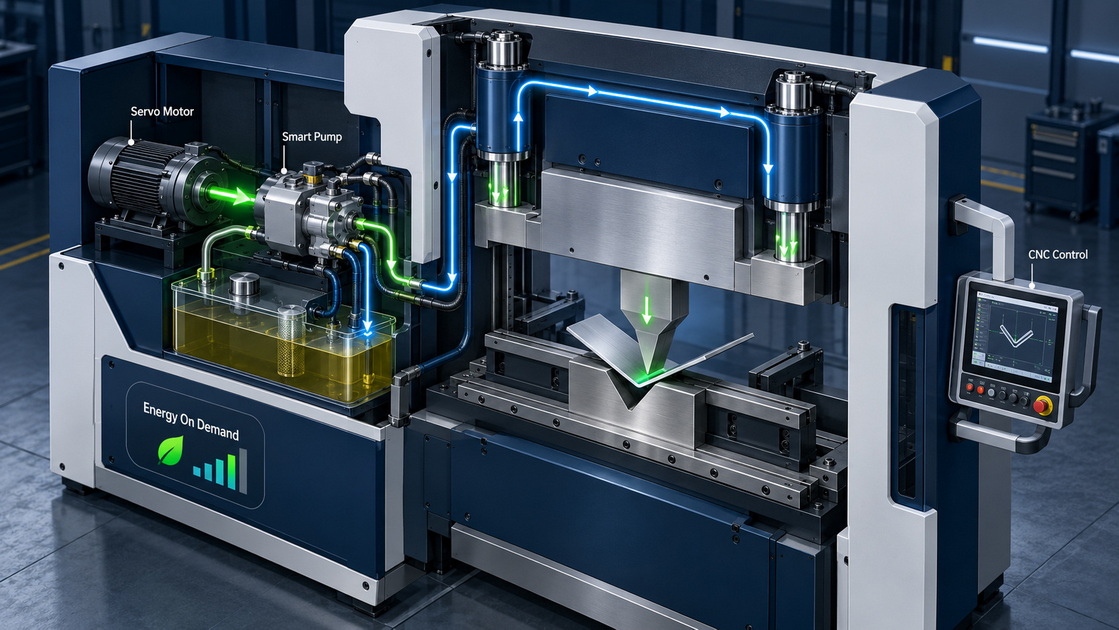
A servo-hydraulic press brake combines hydraulic force with servo-controlled pump operation and CNC synchronization. It is often selected because it retains hydraulic power density while improving responsiveness and energy management compared with older constant-pump hydraulic systems.
For many fabrication plants, this configuration remains the most versatile option because it can handle a broad mix of materials, thicknesses, bending lengths, and production volumes.
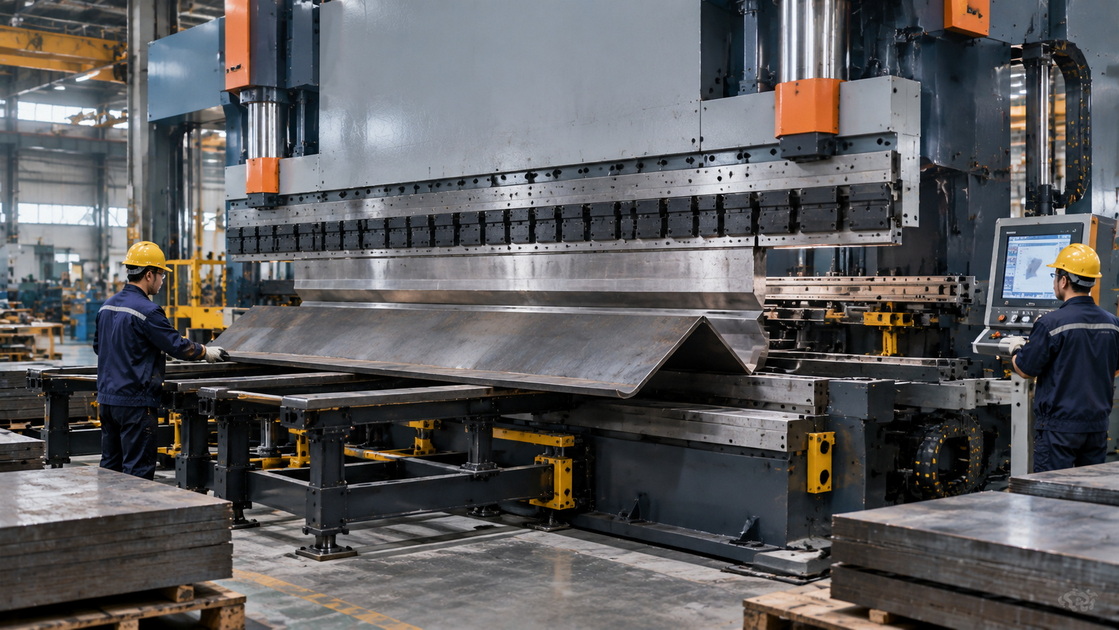
The source article describes servo-hydraulic press brakes as reliable for thick carbon steel, structural components, shipbuilding, construction equipment, and other heavy-fabrication applications where pressing force and robust frame performance are priorities.
- High-force capability for medium and heavy materials.
- Strong fit for long bends and structural parts.
- Familiar hydraulic architecture for many maintenance teams.
- Good balance of price, power, flexibility, and CNC performance.
- Suitable for multi-shift industrial environments when correctly specified.
- Can be configured with hydraulic crowning, multi-axis backgauges, safety systems, and automation.
- Often easier to match with a broad tooling range and conventional fabrication workflows.
- Hydraulic-oil management remains essential.
- Heat, contamination, air ingress, and leakage can affect accuracy and component life.
- Energy savings may be lower than an optimized hybrid configuration under low-load, intermittent work.
- Large high-tonnage machines may require additional cooling, maintenance discipline, and utility planning.
- Noise and energy performance vary significantly between manufacturers.
A practical maintenance reference notes that hydraulic oil must be kept clean and within the machine supplier's specified temperature range. Water contamination, overheating, filtration problems, and debris can contribute to valve sticking, unstable pressure, seal wear, and reduced accuracy.
A hybrid system may be the better option if your workshop primarily bends:
- Thin stainless steel enclosures
- Electrical cabinets
- HVAC panels
- Consumer-appliance components
- Furniture panels
- Electronics housings
- Light automotive brackets
- Precision sheet-metal parts
- Short and repeatable bending programs
- High-mix production with frequent idle intervals
Hybrid models are particularly attractive when your factory operates many short cycles, has high electricity costs, and can document that lower idle power and reduced heat will meaningfully reduce total operating cost.
A practical example: a manufacturer producing thin-sheet stainless-steel electrical enclosures may run hundreds of similar bend cycles per shift. If the machine spends meaningful time in setup, material handling, programming, or idle condition between short runs, a demand-controlled hybrid system may deliver measurable energy and noise advantages.
A servo-hydraulic CNC press brake is often better when the work includes:
- Thick carbon steel
- Long structural panels
- Heavy equipment components
- Truck and trailer parts
- Shipbuilding sections
- Agricultural machinery parts
- Bridge and construction components
- Energy-industry fabrications
- Mixed material thicknesses
- Long workpieces requiring crowning
- High-tonnage or high-load bending
A shop that bends 3 mm panels one day and heavy structural components the next needs a machine with a wide and reliable operating envelope. In these cases, frame rigidity, ram synchronization, crowning, tooling capacity, throat depth, open height, and load-per-meter limits matter more than an isolated energy-saving claim.
Buyers often assume that a hybrid system is automatically more accurate than a servo-hydraulic machine. This is not always true.
Real bending accuracy is influenced by:
- Frame stiffness
- Ram guidance and synchronization
- Cylinder performance
- Encoder quality
- CNC controller algorithms
- Crowning system
- Tooling condition
- Die opening
- Punch radius
- Material thickness variation
- Material tensile-strength variation
- Grain direction
- Springback
- Operator setup
- Backgauge repeatability
- Temperature and hydraulic-oil condition
A well-designed servo-hydraulic press brake with accurate feedback, CNC crowning, quality tooling, and disciplined process control can outperform a poorly configured hybrid machine. Conversely, a hybrid press brake can perform exceptionally well in precision, high-cycle work if the structure, controller, tooling, and material controls are appropriate.
When bending long parts, the press brake's ram and bed deflect under load. Without compensation, the part may show different bend angles at the center and ends.
Crowning systems can be mechanical, hydraulic, or CNC-controlled. For long bends, buyers should ask the supplier:
- Is crowning standard or optional?
- Is it mechanical, hydraulic, or CNC-controlled?
- Can it store settings for different programs?
- Does it compensate according to actual load?
- Can the supplier demonstrate angle consistency on the buyer's part?
Expert insight: For long parts, do not compare only "machine accuracy" from a catalog. Request three measurements from the same test bend: left end, center, and right end. This immediately reveals whether the frame, crowning system, tooling, and setup are working as a system.
Energy claims can be misleading when they compare a new hybrid machine with an older, poorly maintained constant-pump machine.
Use a practical energy-evaluation method:
1. Select one representative part and production program.
2. Use the same material grade, thickness, die, punch, and bend sequence.
3. Record cycle time, idle time, number of bends, and scrap rate.
4. Measure electricity consumption with a power meter.
5. Calculate kWh per finished part.
6. Include setup and warm-up time where relevant.
7. Compare annual operating cost using your local electricity rate.
8. Include the purchase-price difference and estimated maintenance cost.
The financial comparison should look like this:
Annual Energy Cost=kWh Per Finished Part×Annual Part Volume×Electricity Rate
Then compare the estimated annual savings against the additional capital cost, maintenance requirements, and expected machine life.
| Shop Condition | More Likely Fit |
|---|---|
| High number of short, repeatable thin-sheet jobs | Hybrid press brake |
| High electricity cost and frequent machine idle time | Hybrid press brake |
| Heavy plate, long bends, structural components | Servo-hydraulic press brake |
| Mixed work with unpredictable load requirements | Servo-hydraulic press brake |
| Maintenance team familiar with hydraulic systems but limited servo-drive support | Servo-hydraulic press brake |
| Advanced automation and skilled controls support available | Hybrid or servo-hydraulic, based on validated ROI |
| Buyer requires one machine for broad future capacity | Servo-hydraulic press brake with robust frame and crowning |
In the press brake industry, the word hybrid is often used as a marketing label rather than a precise engineering definition.
Two machines described as "hybrid press brakes" may differ in:
- Servo-motor size
- Pump type
- Hydraulic-circuit layout
- Accumulator design
- Ram-drive architecture
- Installed power
- Cooling requirement
- Maximum continuous duty cycle
- Controller brand
- Safety-function architecture
- Spare-parts availability
- Data-monitoring capability
This means buyers should not compare two quotations using only tonnage, working length, and the word "hybrid."
Ask each supplier for the following before placing an order:
- Hydraulic schematic
- Electrical schematic
- Servo motor and pump brand/model
- Installed motor power
- Maximum pressure and oil flow
- Ram speed at approach, working, and return stages
- Measured noise level under defined conditions
- Measured kWh per representative cycle
- Cooling-system specification
- Oil-tank capacity
- Recommended oil type and filtration standard
- Spare-parts list and lead times
- Remote-support process
- Warranty exclusions
- Factory-acceptance-test procedure
A supplier that can provide these details is more likely to understand the machine as a production asset rather than a generic product category.
A press brake's maintenance cost is not limited to oil changes. It includes planned inspection, fluid analysis, filter replacement, seal condition, hoses, pump health, cooling, electrical diagnostics, software backups, encoder calibration, tooling upkeep, and operator training.
- Servo motor and drive diagnostics
- Electrical cabinet cleanliness and cooling
- Pump-condition monitoring
- Encoder and feedback-system checks
- Hydraulic-oil cleanliness
- Filter replacement
- Software backup and parameter control
- Qualified access to electronic spare parts
- Hydraulic-oil cleanliness and level
- Oil temperature and cooler performance
- Hose and fitting inspection
- Valve and pump condition
- Seal and cylinder leakage
- Filter replacement
- Ram synchronization
- Crowning calibration
- CNC controller and backgauge maintenance
Industry maintenance guidance recommends monitoring oil temperature, contamination, moisture, and filtration instead of judging hydraulic fluid by color alone. It also emphasizes using the manufacturer's maintenance intervals and investigating abnormal heat, foaming, leaks, and pressure instability promptly.
For machines sold into the European Union, buyers should prepare for the EU Machinery Regulation 2023/1230, which becomes applicable on January 20, 2027. The regulation replaces Directive 2006/42/EC and establishes requirements for machinery placed on the EU market.
A serious press brake supplier should be prepared to discuss:
- CE conformity documentation
- Risk assessment
- Declaration of Conformity
- Safety circuit architecture
- Emergency-stop design
- Point-of-operation safeguarding
- Laser or optical protection devices
- Electrical schematics
- User manual and maintenance manual
- Machine labels and warning signs
- Software and controller-update policy
- Applicable press-brake safety standards
ISO 6909:2026 specifies safety requirements for press brakes, and buyers should confirm which safety standards apply to the destination market and intended machine configuration.
CNDY-Press is a China-based manufacturer of sheet-metal processing equipment. Its core product scope includes CNC press brakes, fiber laser cutting machines, CNC shearing machines, CNC plate rolling machines, and CNC grooving machines. The company states that it supports OEM and ODM projects and can provide customized production based on customer requirements.
For buyers choosing between hybrid and servo-hydraulic architectures, CNDY-Press can support a structured technical discussion around:
- Material type and thickness range
- Maximum bend length
- Required tonnage and tonnage-per-meter
- Production volume and duty cycle
- Desired CNC controller
- Crowning requirement
- Backgauge-axis configuration
- Safety and export-market requirements
- Tooling system
- Automation or material handling
- Electrical voltage and frequency
- Installation and after-sales support
CNDY-Press states that it has a professional R&D and production team, advanced processing equipment, quality-focused manufacturing, and after-sales support including operational training and equipment maintenance.
Not always. Both may use servo-driven hydraulic power, but manufacturers use the terms differently. Ask for the hydraulic and electrical schematics, motor/pump specifications, and measured performance data instead of relying on the product name.
A hybrid press brake may save more energy in high-cycle, low-to-medium-load, or idle-heavy operations because its servo-driven pump can operate according to demand. However, savings depend on the machine design, duty cycle, part program, material, production volume, and comparison baseline. A study of variable-speed pump control in a press brake reported up to 54% savings across 100 cycles compared with a conventional valve-controlled system, but this is not a universal result.
Yes. Servo-hydraulic press brakes are often selected for medium-to-heavy bending because they combine hydraulic force with CNC control and can be configured with rigid frames, hydraulic crowning, appropriate tooling, and multiple backgauge axes. Final suitability depends on calculated tonnage, bend length, die opening, material strength, and tooling capacity.
It may reduce heat and some wear associated with continuously running hydraulic systems, but it still requires maintenance. Hybrid machines need hydraulic-fluid management, filter servicing, electrical inspection, servo-drive diagnostics, encoder checks, and software control. Maintenance requirements should be compared using the supplier's service schedule and local support capability.
Ask for kWh per finished part using the same material, thickness, tooling, bend sequence, cycle time, and idle assumptions. Compare annual energy cost using your local electricity rate, then include purchase price, maintenance, downtime exposure, and expected machine life.
1. Prima Press. "Hybrid vs Servo-Hydraulic Press Brakes: What's the Best Choice for You?" [https://www.prima-press.com/hybrid-vs-servo-hydraulic-press-brakes-whats-the-best-choice-for-you/]. Original source article covering working principles, application fit, maintenance, and broad performance differences between hybrid and servo-hydraulic press brakes. [prima-press]
2. CNDY-Press. "About Us." [https://www.cndypress.com/aboutus.html]. Company profile outlining CNDY-Press's sheet-metal equipment product range, OEM/ODM support, custom-production capability, industry applications, R&D team, manufacturing approach, and after-sales service. [cndypress]
3. Atlas T-JES. "An Investigation of Efficiency of Servo Motor Drive Hybrid Press Brake System: A Comparative Study With a Traditional Application." [https://www.atlas-tjes.org/index.php/tjes/article/view/426]. Experimental study comparing conventional valve-controlled and variable-speed-pump-controlled press brake systems; reports energy-saving results under the study's specific test conditions. [atlas-tjes]
4. European Commission, EUR-Lex. "Regulation (EU) 2023/1230 on Machinery." [https://eur-lex.europa.eu/eli/reg/2023/1230/oj/eng]. Official text of the EU Machinery Regulation replacing Directive 2006/42/EC. [eur-lex.europa]
5. European Agency for Safety and Health at Work. "Regulation (EU) 2023/1230—Machinery." [https://osha.europa.eu/en/legislation/directive/regulation-20231230eu-machinery]. Overview stating that Regulation (EU) 2023/1230 applies from January 20, 2027. [osha.europa]
6. European Commission. "Machinery: Internal Market, Industry, Entrepreneurship and SMEs." [https://single-market-economy.ec.europa.eu/sectors/mechanical-engineering/machinery_en]. Official guidance on machinery legislation and applicability of the EU Machinery Regulation from January 20, 2027. [single-market-economy.ec.europa]
7. ISO. "ISO 6909:2026: Machine Tools—Safety—Press Brakes." [https://www.iso.org/obp/ui/ru/]. International standard describing safety requirements for press brakes. [iso]
8. Shenchong. "CNC Press Brake Maintenance Guide." [https://www.shenchong.com/cnc-press-brake-maintenance-guide.html]. Practical discussion of hydraulic-oil temperature, fluid selection, contamination, and routine press-brake maintenance. [shenchong]
9. CNHAWE. "Press Brake Maintenance Checklist." [https://www.cnhawe.com/press-brake-maintenance-checklist/]. Maintenance guidance addressing oil temperature, contamination, filtration, hydraulic-service intervals, and inspection considerations. [cnhawe]
10. ADH Machine Tool. "Press Brake Preventive Maintenance Checklist: Daily to Annual Tasks." [https://www.adhmt.com/press-brake-preventive-maintenance-checklist-daily-to-annual-tasks/]. Preventive-maintenance guidance on contamination, water ingress, oil condition, hoses, temperature, and condition-based service. [adhmt]


