


Views: 257 Author: CNDY-Press Publish Time: 2026-06-26 Origin: Site


Content Menu
● Fundamentals Of Tube Bending: Parameters You Must Know
● Core Tube Bending Calculations: Moment, Force, And Arc Length
● Wall Thinning And Structural Integrity
● Why Your 90° Bend Is Actually 87° Without Compensation
● Bend Allowance And Bend Deduction: Getting Layout Right
● Practical Tube Bending Workflow For CNC Shops
● CNDY‑Press Perspective: From Calculations To Complete Bending Solutions
● Example Table: Practical Tube Bending Rules Of Thumb
● Common Pitfalls In Tube Bending Projects (And How To Avoid Them)
● Call To Action: Turn Tube Bending Calculations Into Reliable Production
● FAQ
In every fabrication shop I've worked with, poor tube bending calculations show up first as scrap, then as rework, and finally as missed delivery dates. Whether you are bending tubes on a dedicated tube bender or forming profiles with a CNC press brake, understanding how to calculate tube bending is the difference between repeatable production and guesswork. [leonhardtmfg]
In this guide, I'll walk through the core formulas from the original "How To Calculate Tube Bending" article, add practical shortcuts used by experienced fabricators, and connect them to real CNC equipment decisions—so engineers and buyers can speak the same language when specifying bending projects with OEM/ODM partners like CNDY‑Press. [xometry]
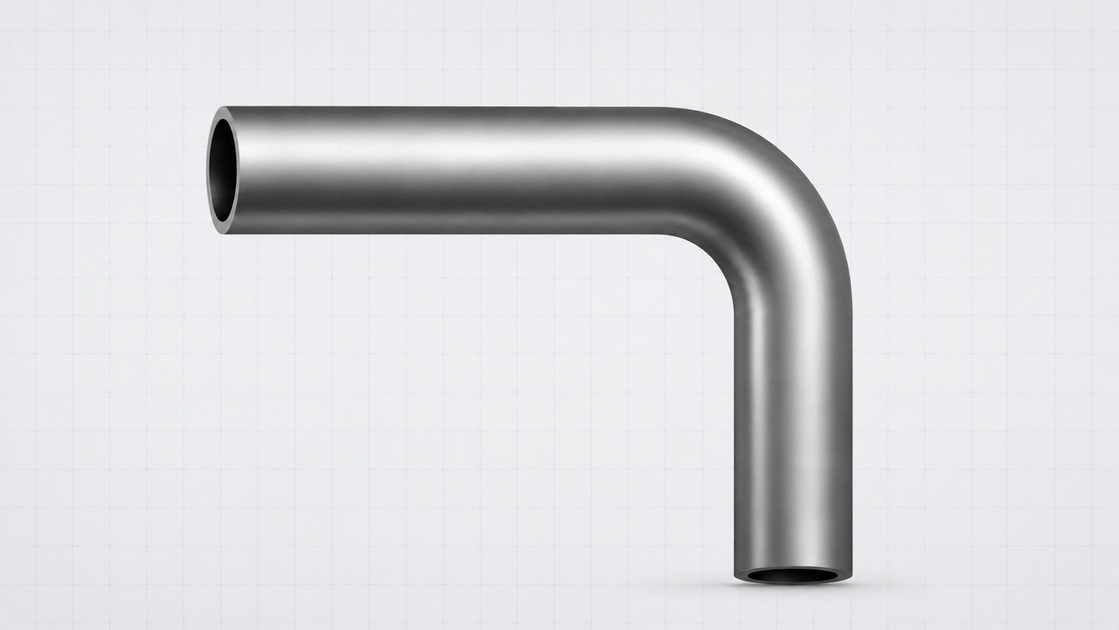
Before you even touch a tube, you need to define a small set of non‑negotiable parameters. [bendtooling]
- Tube material: Yield strength, ductility, and work‑hardening rate directly impact minimum bend radius and the risk of cracking. [zemanmfg]
- Tube dimensions: Outer diameter \(D\), inner diameter \(d\), and wall thickness \(t\) drive section modulus, moment of inertia, and minimum bend radius. [bendtooling]
- Centerline bend radius (CLR): Radius of the curved path measured to the tube centerline; this is the reference radius for most practical formulas. [benderparts]
- Bending angle: The angle you need in the finished part—90°, 180°, or any custom angle. [shop.chapmanelectric]
Get these wrong, and even the most advanced CNC press brake or tube bender will produce inconsistent parts.
The original article explains that tube bending starts with the bending moment M:
M=σ×Z[5]
where \( \sigma \) is the stress in the tube wall and \( Z \) is the section modulus. For a circular tube: [bendtooling]
Z=π/32(D4−d4)[6]
Once \(M\) is known, the bending force \(F\) required at the tool radius can be estimated (conceptually) via:
F=M/R[9]
with \(R\) as the bend radius. In practice, experienced shops rely on machine tonnage charts and supplier data to complement these formulas, especially for large‑diameter or high‑strength materials. [southernfabsales]
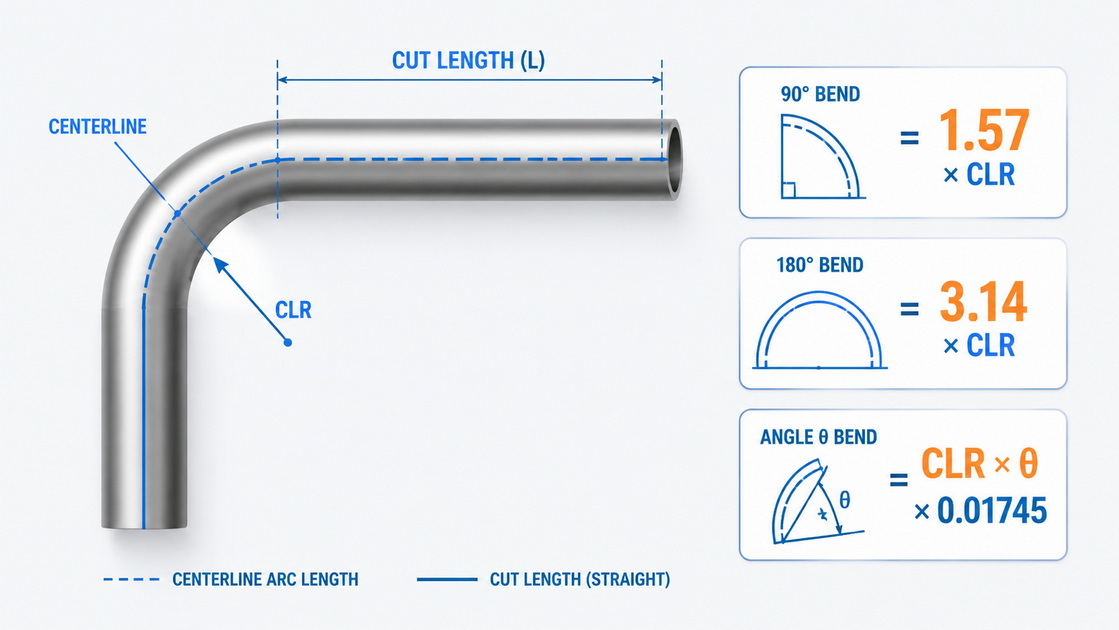
For layout and cutting, you must know how much tube sits inside each bend. A widely used shortcut is: [roguefab]
- For a 90° bend: arc length Lb≈1.57×CLR.[benderparts]
- For a 180° bend: Lb≈3.14×CLRL. [roguefab]
- For any angle \(\theta\):
Lb≈CLR×θ×0.01745[11]
These shop formulas match the formal arc calculation Lb=(π/180)×θ×CLR, but they are faster to apply when you are marking cut lengths on real tubing. [shop.chapmanelectric]
Wall thinning is one of the most critical risks in tube bending. The original article introduces a wall thinning factor:
t′=t(1−σy/σf)[8]
where t is the original wall thickness, σy is yield strength, and σf is flow stress. Flow stress σf can be approximated via Ramberg–Osgood to capture nonlinear material behavior under plastic bending. [zemanmfg]
From a practical engineer's perspective:
- As you push radius below the recommended minimum (often around 2×D2 ), wall thinning and ovality become unacceptable. [xometry]
- High‑elongation materials like certain steels and aluminum alloys tolerate tighter radii better than brittle materials. [xometry]
When specifying projects to a manufacturer such as CNDY‑Press, buyers should provide target minimum wall thickness and acceptable ovality so process engineers can choose appropriate tooling and methods.
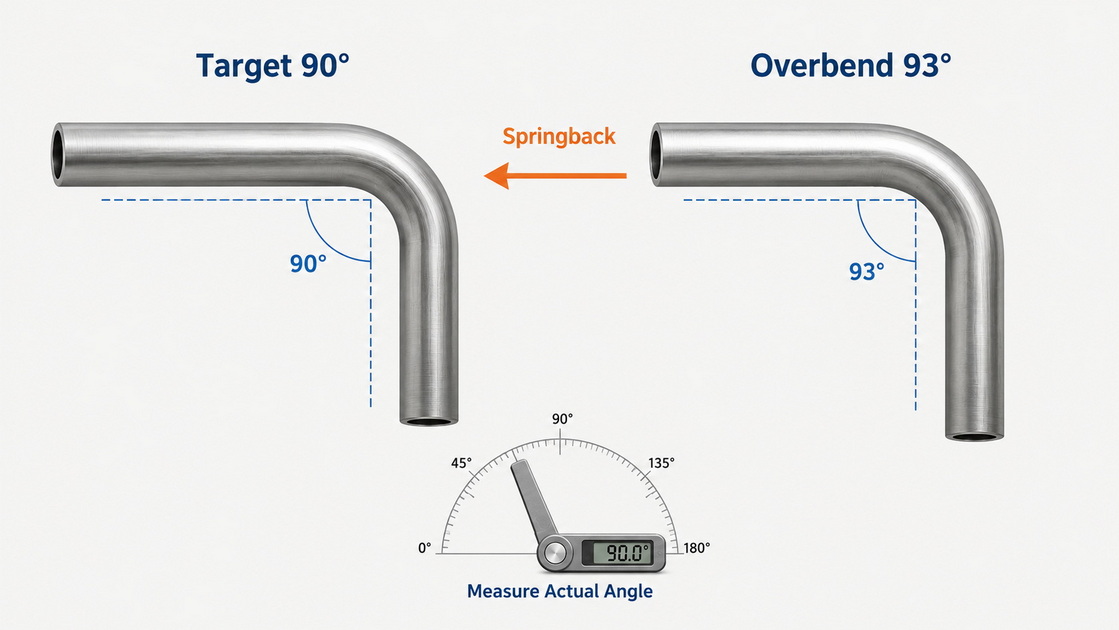
Springback is the elastic recovery that happens when bending forces are removed. The original article gives a conceptual springback angle formula: [youtube]
Δθ=E×I/M×L[1]
with Young's modulus E, moment of inertia I, bending moment M, and bend length L.
In day‑to‑day operations, shops often:
- Overbend by a small, predictable amount (for example, bending to 93° to achieve a final 90°). [benderparts]
- Maintain material‑specific springback data in their CNC controllers for repeatability. [youtube]
CNC press brakes and tube benders with springback compensation and precise angle measurement dramatically reduce trial‑and‑error, especially when producing complex multi‑bend geometries for automotive or structural components. [fab-line]
For layout and flat‑pattern development, the original article provides formulas for bend allowance (BA) and bend deduction (BD). [shop.chapmanelectric]
Bend allowance:
BA=π/180×(R+K×t)×(θ−α)[3]
Bend deduction:
BD=2×(R+K×t)×(sin2θ−sin2α)[14]
where R is bend radius, K is K‑factor (typically 0.3–0.5), t is wall thickness, θ is bending angle, and α is neutral‑axis correction. [myssp]
Once you have BA and BD, you can:
- Accurately determine cut lengths before bending.
- Mark vertex positions for multi‑bend tubes and profiles using pocket‑guide tables or CNC programming tools. [edmontonsolutions.swagelok]
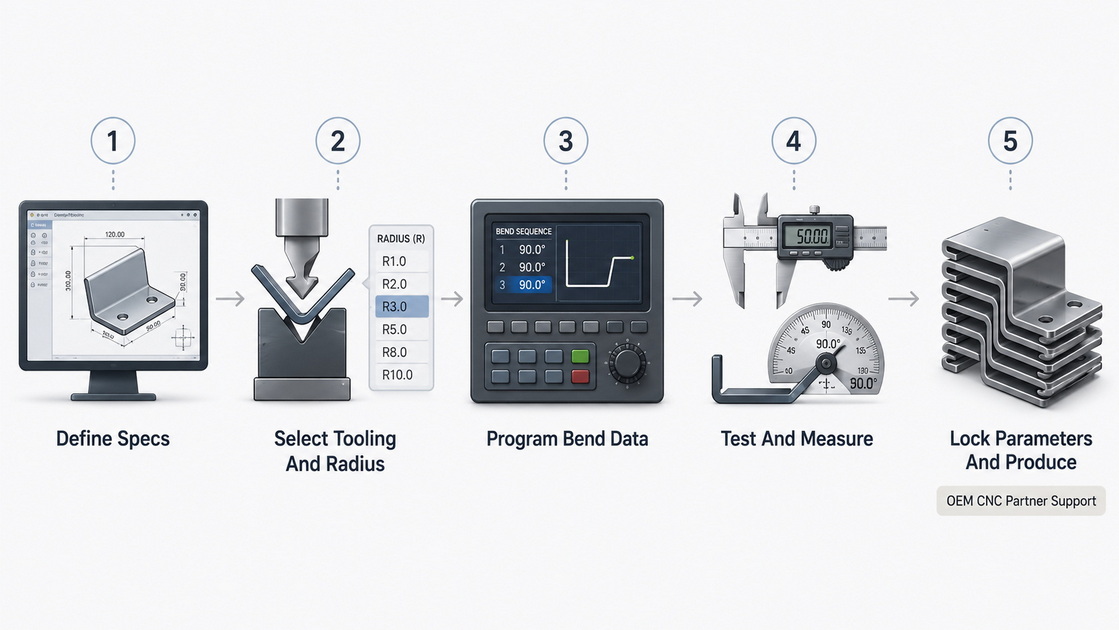
Based on field experience and the original calculation framework, here is a practical workflow used in modern CNC shops:
1. Define specifications clearly.
Material grade, OD/ID, wall thickness, angles, CLR, permissible wall thinning, and allowable ovality. [leonhardtmfg]
2. Select equipment and tooling.
Decide between a dedicated tube bender or forming profiles on a CNC press brake; choose appropriate dies, mandrels, and backgauges. [vicla]
3. Calculate initial bend data.
Use formulas for arc length, BA/BD, and springback to determine cut length and target angles; store values in CNC programs. [myssp]
4. Run test bends and measure.
Check angles, wall thinning, ovality, and distance between bends; adjust springback compensation and tooling as needed. [edmontonsolutions.swagelok]
5. Lock parameters and document.
Once stable, record bend data, machine settings, and inspection criteria for future batches or OEM/ODM runs. [southernfabsales]
CNDY‑Press supports this workflow by providing equipment that integrates angle measurement, programmable gauging, and tooling libraries so engineers can move from formula to repeatable production quickly.
CNDY‑Press specializes in CNC press brakes and sheet‑metal forming equipment, and works with customers worldwide on OEM and ODM bending projects. While tube bending is typically performed on dedicated tube benders, many structural and frame components combine tube and sheet bends, requiring careful coordination between machines. [vicla]
In practice, that means:
- Helping customers select press brake tooling that matches tube and sheet bend radii for consistent assembly. [fab-line]
- Offering custom control interfaces that store bend libraries, springback compensation, and material data for different projects. [youtube]
- Providing application engineering support to translate drawings and formulas into robust CNC programs and tooling packages.
For global buyers, working with a manufacturer like CNDY‑Press reduces the gap between theoretical calculation and shop‑floor execution, especially on complex assemblies that mix tubes, channels, and sheet parts in one welded structure.
| Parameter | Typical guideline | Source / rationale |
|---|---|---|
| CLR vs OD | CLR ≥ 2 × OD for most steels to reduce wrinkling and excessive thinning. (xometry) | Common design tip for manufacturability. (xometry) |
| 90° bend arc length | Lb≈1.57×CLR. (benderparts) | Simplified arc formula used in shops. (benderparts) |
| 180° bend arc length | Lb≈3.14×CLR. (benderparts) | Half‑circle arc length. (benderparts) |
| Overbend for springback | Typically 2–5° over target angle, depending on material and thickness. (youtube) | Empirical adjustment refined per material. (youtube) |
| Minimum wall thinning | Often limited to ≤ 10–15% for structural parts unless otherwise specified. (zemanmfg) | Industry practice for integrity and fatigue life. (zemanmfg) |
This type of table gives designers and buyers a quick reality check on whether their drawings and specifications are manufacturable on standard equipment.
Industry experience reveals a few recurring issues that aren't always covered in basic formula guides:
- Ignoring distance between bends: Poorly planned bend spacing leads to collisions or impossible tool loading; use offset tables and pocket guides to calculate these distances correctly. [myssp]
- Underestimating fixturing and alignment: If parts are hard to hold, they are hard to bend consistently; good fixturing and gauging are as important as the formulas. [leonhardtmfg]
- Mixing tight radii with low‑ductility materials: Specifying tight CLR for materials with low elongation leads to cracks and excessive thinning; pick materials with suitable elongation or relax radius requirements. [zemanmfg]
Experienced OEM partners build these checks into their DFM (design for manufacturability) review and flag risky designs early, saving time and cost.
Accurate tube bending calculations are the foundation of reliable manufacturing—but they only deliver value when combined with the right equipment, tooling, and process controls. If you're planning new tube or profile bending projects, consider: [fab-line]
- Reviewing your drawings against the rules of thumb and formulas outlined here.
- Engaging with a manufacturer like CNDY‑Press to evaluate equipment, tooling, and programming options for your parts.
- Building a bend data library (arc lengths, BA/BD, springback values) that your engineering and production teams can share across projects.
With these steps, you move tube bending from a trial‑and‑error process to a controlled, repeatable operation supported by solid calculations and modern CNC technology.
1. How do I choose a realistic centerline radius for a new tube design?
Start from material elongation data and common guidelines such as CLR ≥ 2 × OD for steels, then consult your bending partner's tooling catalog to ensure the chosen radius is available and economical. [xometry]
2. Can I rely only on formulas for springback, or do I need empirical testing?
Formulas provide a baseline, but practical springback compensation must be tuned by test bends and recorded per material, thickness, and tooling; modern CNC controls store these empirical values. [southernfabsales]
3. How do I manage multi‑bend parts with tight tolerances?
Use vertex‑based layout, bend allowance/deduction tables, and dedicated pocket guides, and plan fixturing carefully to ensure consistent distance between bends and accurate angular relationships. [edmontonsolutions.swagelok]
4. What's the role of CNC press brakes in tube‑related projects?
CNC press brakes often form sheet or plate components that mate with bent tubes in frames and structures; matching bend radii, tolerances, and springback behavior across both machine types improves assembly quality. [vicla]
5. When should I consider finite element analysis (FEA) for tube bending?
Use FEA for complex geometries, high‑strength materials, or safety‑critical parts where wall thinning and stress distribution must be predicted more precisely than simple analytical formulas allow. [zemanmfg]
1. Chapman Electric – "Formulas for Calculating Conduit & Pipe Bends" – arc and trigonometric calculations.
<https://shop.chapmanelectric.com/resources/formulas-for-calculating-conduit-pipe-bends> [shop.chapmanelectric]
2. Bend Tooling – "Tube Bending Calculations & Formulas" – section modulus and radius relationships.
<https://bendtooling.com/tube-bending-formulas/> [bendtooling]
3. UTB Michigan – "How Do You Calculate the Bend of a Tube?" – practical CLR and arc‑length shortcuts.
<https://www.benderparts.com/how-do-you-calculate-the-bend-of-a-tube/> [benderparts]
4. Rogue Fab – "Tube Bending 101: The Complete Beginner's Guide" – shop‑floor bend length multipliers.
<https://www.roguefab.com/bending-101/> [roguefab]
5. SSP Fittings – "Tube Bender Pocket Guide" – vertex layout, gain, and bend allowance tables.
<https://www.myssp.com/hubfs/Final%20Docs/Catalogs/Tools/Tube%20Bender%20Pocket%20Guide%20SSPTBPG-24A.pdf> [myssp]
6. Xometry – "Top Tube Bending Design Tips" – CLR/OD guidelines and material elongation advice.
<https://www.xometry.com/resources/tube/tube-bending-design-tips/> [xometry]
7. Leonhardt Manufacturing – "Tube Bending Design Guidelines for Better Production" – fixturing and repeatability insights.
<https://www.leonhardtmfg.com/blog/tube-bending-design-guidelines/> [leonhardtmfg]
8. Zeman Manufacturing – "The Hidden Challenges of Precision Tube Bending" – process variability and control.
<https://www.zemanmfg.com/post/the-hidden-challenges-of-precision-tube-bending> [zemanmfg]
9. Fab‑Line Machinery – "Mastering Press Brake Bending Techniques" – press brake fundamentals.
<https://www.fab-line.com/news/press-brake-bending-techniques/> [fab-line]
10. VICLA – "Mastering Press Brake Tooling: A Comprehensive Guide" – punch/die alignment and tonnage considerations.
<https://www.vicla.eu/en/blog/press-brake-tooling> [vicla]
11. Southern Fab Sales – "4 Press Brake Bending Basics You Need to Know" – material, thickness, and tooling accuracy.
<https://www.southernfabsales.com/blog/press-brake-bending-basics> [southernfabsales]


