


Views: 250 Author: CNDY-Press Publish Time: 2026-07-20 Origin: Site


Content Menu
● Why 90-Degree Tube Bends Matter
● What You Need Before Bending
>> Recommended machine considerations
● Material Factors That Change the Result
● How to Bend Aluminum Tubing 90 Degrees
>> Step 1: Measure and mark accurately
>> Step 2: Calculate bend allowance
>> Step 3: Clean and prepare the tube
>> Step 5: Bend slowly and steadily
>> Step 6: Inspect the finished bend
● Advanced Methods for Better Results
● When to Use a Press Brake or Tube Bender
● Production Insight for OEM and ODM Buyers
>> 1. Can all aluminum tubing be bent to 90 degrees?
>> 2. What causes aluminum tubing to kink during bending?
>> 3. How do I choose the right bending method for production?
>> 4. Do I need to heat aluminum tubing before bending?
>> 5. How can I minimize springback in aluminum tube bending?
Bending aluminum tubing 90 degrees looks simple at first glance, but achieving a clean bend without kinking, collapsing, or cracking demands controlled technique rather than brute force. In real fabrication work, success depends on material selection, wall thickness, bend radius, tooling, and how well the tube is supported during the process. This guide explains the full workflow in a practical way, with a strong focus on shop-floor accuracy, repeatability, and professional-quality results.
For manufacturers, fabricators, and buyers in automotive, aerospace, HVAC, furniture, and custom equipment sectors, this topic has direct impact on product quality and production cost. Poor tube bending leads to scrap, rework, and inconsistent assemblies, while a controlled process supports stable output, tighter tolerances, and smoother downstream operations. If you are planning production at scale, choosing the right bending method and equipment can make a measurable difference to efficiency, yield, and long-term reliability.
A 90-degree bend is one of the most common shapes in metal fabrication because it supports routing, framing, support structures, enclosures, and fluid or air movement. In practice, it appears wherever a compact change of direction is needed without adding separate connectors or welded joints. That makes the bend both a structural and cost-control decision.
A well-executed bend can reduce part count, shorten assembly time, and simplify the overall design of frames, brackets, and tubular structures. A poor bend, however, can create ovality, distortion, and internal stress that may weaken performance or complicate fit-up during assembly. For that reason, professional fabricators treat tube bending as a controlled process with defined parameters, not as trial-and-error work done on the fly.
Before any bending operation, it is essential to verify the tube material, outside diameter, wall thickness, and temper. These factors determine whether the tube can be safely formed in the desired radius and how much springback to expect after unloading. Softer aluminum alloys generally bend more easily, while harder or thicker-walled tubing demands more force and better tooling to avoid defects.
- Tube bender suitable for the tubing diameter and bend radius
- Measuring tools such as calipers, steel ruler, and protractor
- Permanent marker or scribe for layout and bend marks
- Clamps or holding fixtures to stabilize the workpiece
- Compatible lubricant for the bending operation
- Safety glasses and gloves for personal protection
For one-off or light work, a manual bender can be sufficient, especially in repair or prototyping environments. In industrial settings, hydraulic or numerically controlled bending equipment offers far better consistency and throughput. When parts must conform to tight tolerances and fit into complex assemblies, repeatability matters as much as the angle itself. For OEM and ODM projects, selecting the correct machine class early prevents costly process adjustments later and supports reliable production runs.
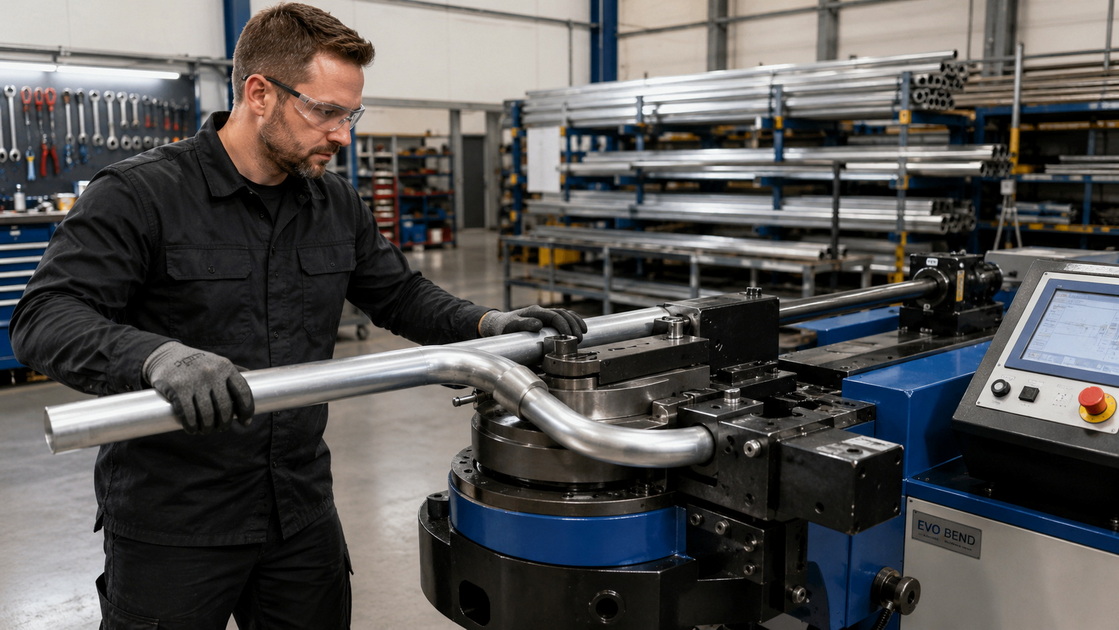
Not all aluminum tubing behaves the same under load. Alloy choice affects ductility, cracking risk, and the amount of springback after bending. Wall thickness plays a major role as well: thin walls are more prone to flattening or collapse, while thicker walls require greater force and more robust tooling.
| Factor | Why it matters | Practical impact |
|---|---|---|
| Alloy type | Different alloys bend differently | Influences cracking risk and springback |
| Wall thickness | Thin walls deform more easily | Raises ovality or collapse risk |
| Bend radius | Smaller radii increase stress | Tight bends are harder to form cleanly |
| Tube diameter | Larger tubes need more support | Requires stronger tooling and control |
| Surface condition | Dirty or scratched tubing bends worse | Can increase friction and surface damage |
The smartest approach is to evaluate the tube before committing to full production. For new jobs or new suppliers, a small test batch shows whether the material can handle the intended radius without unacceptable deformation. This is particularly useful in custom manufacturing where alloy type, temper, or wall thickness may vary from one project to another.
The process below is designed to help you achieve a clean, repeatable 90-degree bend. Following each step carefully reduces the risk of scrap and supports better dimensional control.
Begin by measuring the required tube length and marking the precise start point of the bend. If the bend location is incorrect, the finished part will be wrong even if the angle is perfect. Use a steel ruler or tape for linear dimensions and confirm the layout from the drawing or prototype before proceeding. Clear marks and consistent measuring practice are the foundation of accurate bending work.
Bend allowance is the additional material needed to account for the curvature of the bend. It ensures that the final part length matches the design even after the tube is formed. A commonly used formula is:
Bend Allowance = (π × Bend Radius × Bend Angle) / 180
For a 90-degree bend, this simplifies to:
Bend Allowance = (π × Bend Radius) / 2
By incorporating bend allowance into your calculations, you reduce dimensional errors, especially in assemblies where multiple bends and straight sections must align. Even small inaccuracies can accumulate over several bends, so applying this calculation pays off in more consistent fit-up and reduced adjustment work.

Clean the tube surface to remove dirt, oil, oxide, and debris from the bend area. A clean, smooth surface reduces friction and helps the tube seat correctly in the dies. Where appropriate, apply a compatible lubricant to the bend zone to minimize galling and improve the interaction between tube and tooling. Good preparation lowers the risk of surface defects and helps the tooling work as intended.
Select the correct die for the tube diameter and install it according to the machine's setup procedure. Adjust the machine to the target angle and align the bend mark with the reference point on the die or forming head. At this stage, it is crucial to secure the tube firmly so it cannot shift during the bend. Misalignment or slippage during forming is a common source of dimensional error and unwanted distortion.
Apply pressure gradually, maintaining a smooth and controlled motion. Avoid sudden or jerky movements that can cause kinks or localized damage. Watch the bend closely as the tube forms, and pause if alignment begins to drift. A steady, deliberate bend produces a more uniform radius and keeps internal stresses within acceptable limits.
After the bend reaches 90 degrees, remove the tube and inspect it carefully. Check the angle with a protractor or angle finder and verify that there are no cracks, splits, or excessive flattening in the bend zone. Examine the surface for deep tooling marks or scuffs that might affect aesthetics or performance. If the part belongs to an assembly, test-fit it to a jig or reference component to confirm that the geometry is correct.
In demanding applications, especially those involving thin-wall tubing or tight radii, simple manual bending may not provide the required quality. Advanced methods can significantly improve shape accuracy and reduce failure rates, particularly when roundness and internal diameter must be preserved.
Mandrel bending uses an internal support inserted into the tube before forming. The mandrel holds the tube's inside diameter during the bend, helping it retain a round shape and preventing collapse. This method is widely used in performance exhaust systems, fluid and gas lines, and other applications where internal flow characteristics and structural integrity are critical. Although tooling is more complex, the quality of the bend often justifies the investment.

Multi-stage bending achieves the final angle through several smaller steps rather than one aggressive movement. This approach lowers concentrated stress on the material and gives the operator finer control over shape and alignment. It is useful for complex geometries, decorative parts, or any situation where the visual appearance of the bend is as important as its function.
Hydraulic bending offers controlled force and smoother motion than basic manual tools, making it suitable for larger diameters and thicker walls. Numerically controlled systems add programmable angles, positions, and sequences, allowing the same bend pattern to be reproduced across large batches. In production environments, this combination supports better dimensional consistency, faster setup, and more predictable throughput. When parts must pass strict quality checks, these systems deliver a level of repeatability that is difficult to match manually.
Many bending problems arise from process errors rather than bad material. Understanding common mistakes helps prevent defects and reduces scrap.
Frequent issues include:
- Using an incorrect die size that does not match the tube
- Ignoring bend allowance, leading to incorrect final length
- Marking the bend location inaccurately, causing poor fit-up
- Bending too fast, which increases the risk of kinks and cracks
- Failing to account for springback, resulting in under-bent parts
- Skipping detailed inspection, allowing defects to reach assembly
In a batch-production setting, one flawed setup can produce many defective parts before the problem is discovered. A short verification step at the beginning of every job is a low-cost way to catch errors early and protect overall productivity.
A robust inspection routine ensures that each bend meets geometric and visual requirements. This is especially important where tubing is visible on finished products or must fit within welded frames, brackets, or enclosures.
1. The bend angle is truly 90 degrees according to measuring tools.
2. The tube shows no cracks, splits, or sharp creases in the bend zone.
3. The tube remains sufficiently round, with flattening within tolerance.
4. The surface is free of deep gouges or marks from tooling.
5. The part fits correctly into the intended jig, fixture, or assembly.
For repeat jobs, keeping a reference sample is helpful. Operators can compare the new part to the approved sample and detect deviations more quickly than by relying on memory alone.

A press brake is designed primarily for bending sheet metal and plate, not round tubing. While specialized tooling can adapt a press brake for certain profiles, it is generally not the ideal choice for forming round aluminum tubing to 90 degrees. Dedicated tube bending equipment provides the necessary support and tooling geometry to preserve tube shape and structural integrity.
In many fabrication operations, both processes work together. Sheet-metal parts such as brackets, gussets, and panels may be formed on a press brake, while structural or functional tubing is shaped on dedicated tube bending machines. Coordinating these processes within a single production flow allows frames, enclosures, and assemblies to be manufactured efficiently with consistent fit and alignment.
For OEM and ODM projects, tube bending is part of a broader design-for-manufacturing strategy. The chosen bend radius, material specification, and process path affect not only part quality but also production cost, lead time, and long-term reliability. Sometimes a small design change, such as a slightly larger bend radius or an adjusted wall thickness, can dramatically improve manufacturability without compromising performance.
A capable manufacturing partner should offer more than just equipment or basic bending services. The best partners help evaluate feasibility, suggest suitable alloys and wall thicknesses, and guide tooling selection before mass production begins. That early-stage support reduces risk, minimizes later design changes, and improves the odds that the first full run meets both technical and commercial expectations.
The most reliable way to achieve a clean 90-degree bend in aluminum tubing is to combine accurate measurement, correct tooling, careful calculation of bend allowance, controlled bending speed, and systematic inspection. For single projects and light work, simple tools can be effective when used carefully. For ongoing production, especially when quality and dimensional consistency are critical, more advanced equipment and a stable process deliver better long-term results.
Aligning the bending method with part geometry, material specification, and volume early in the project cycle reduces scrap, improves assembly fit, and contributes directly to overall manufacturing efficiency. Whether you are a small fabricator or a large industrial producer, treating tube bending as a well-defined process rather than a minor detail will pay off in more reliable components and smoother operations.
Not all aluminum tubing can be bent to 90 degrees without damage. The ability to bend safely depends on the alloy, wall thickness, temper, and bend radius. Softer, more ductile alloys with suitable wall thickness usually bend well, while harder or very thin-walled tubing may crack, wrinkle, or collapse if the radius is too tight or the tooling is not appropriate.
Kinking is typically caused by an overly tight bend radius, insufficient support inside or outside the tube, or bending too quickly. Using the wrong die size, failing to clamp the tube securely, and ignoring bend allowance can also contribute to local buckling. A properly sized die, gradual forming motion, and, where necessary, internal support such as a mandrel all help reduce the risk of kinks.
The right bending method depends on your volume, tolerance requirements, and tube specifications. For low-volume work and simple geometries, manual or basic hydraulic benders can be sufficient. For higher-volume production, tight tolerances, or thin-wall tubing, mandrel bending and numerically controlled equipment are usually more suitable. Evaluating alloy type, diameter, wall thickness, and bend radius will guide whether simple tooling or more advanced systems are needed.
Most aluminum tubing used in general fabrication can be bent at room temperature when the radius and tooling are correctly selected. However, certain alloys, tempers, or very tight radii may require special handling or process adjustments. Rather than relying on heat, it is generally better to optimize material choice, bend radius, and tooling configuration to keep the process consistent and avoid unintentionally weakening the tube.
Springback is influenced by alloy hardness, wall thickness, and bend radius. To minimize it, use properly matched tooling and apply controlled, steady pressure rather than abrupt force. In many cases, operators intentionally overbend slightly beyond the target angle so the tube settles to the desired degree after unloading. Recording the typical springback for each material and bend geometry allows more predictable setup for future jobs.
1. HUNSONE, "How To Bend Aluminum Tubing 90 Degrees,"
https://www.hunsone.com/how-to-bend-aluminum-tubing-90-degrees/
2. HUNSONE, "How To Bend Sheet Metal 90 Degrees,"
https://www.hunsone.com/how-to-bend-sheet-metal-90-degrees/
3. Google Search Central, "Creating helpful, reliable, people-first content,"
https://developers.google.com/search/docs/fundamentals/creating-helpful-content


