


Views: 222 Author: CNDY-Press Publish Time: 2026-06-11 Origin: Site


Content Menu
● How To Evaluate A CNC Press Brake Supplier (Experience First)
● CNC Press Brake Basics: Main Components And Their Roles
● Hydraulic, Electric, Servo And Hybrid
● The Role Of Crowning: Keeping Bends Straight Across The Length
● How The CNC System Actually Controls The Bend
● Bending Methods: Air Bending, Bottoming And Coining
● What Actually Happens During A CNC Bending Cycle
● Industry 4.0, Automation And Robotic Bending Cells
● Practical Selection Checklist For CNC Press Brakes
● An Insider Pitfall – Silent Tonnage And Tooling Mismatch
● Comparison Overview: CNC Press Brake Drive Types
● Where CNDY‑Press Fits In Your Sourcing Strategy
● Conclusion: Turning CNC Theory Into Shop‑Floor Results
● FAQ
When you run a busy fabrication shop, a CNC press brake is usually the bottleneck or the backbone of your bending department—sometimes both in the same week. Over the past 15 years working with fabrication managers and OEM buyers, I have seen the difference between an outdated manual brake and a well‑configured CNC system translate directly into throughput, scrap rate, and operator safety. [adhmt]
Today's CNC press brakes combine hydraulic or electric drive systems with numerical control, 2D/3D programming, and smart backgauges to deliver repeatable, high‑precision bends across a wide range of materials. If you are evaluating machines from brands like TRUMPF, Amada, Bystronic or emerging players, or from manufacturers such as CNDY‑Press, understanding how these machines actually work will help you specify the right tonnage, length, and automation level for your projects. [youtube]
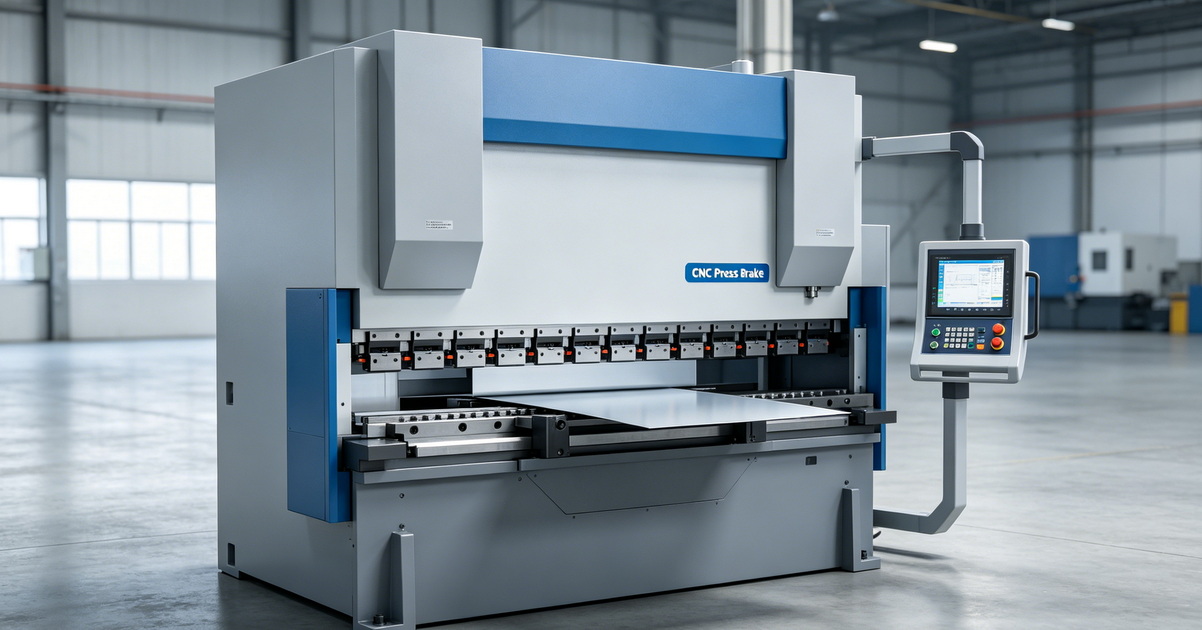
Before diving into the mechanics, it is worth clarifying how experienced buyers evaluate CNC press brake manufacturers and integrators. From my project work with global OEMs and job shops, four dimensions consistently separate reliable partners from risky ones:
- Factory capability and certifications – Look for ISO 9001, CE compliance for machinery, and documented risk assessments for safety and electrical systems. [shiniteknife]
- R&D and application engineering – Strong suppliers can advise on tool selection, bending methods (air, bottom, coining), and even redesign parts to reduce tonnage and tool changes. [youtube]
- QC and testing procedures – Ask how they test frame stiffness, parallelism, backgauge accuracy, and run‑off procedures before shipment. [printivity]
- After‑sales support and spare‑parts strategy – Availability of remote diagnostics, local technicians, and stocked critical components often matters more than a slightly lower purchase price. [blmamachinery]
As a manufacturer, CNDY‑Press positions itself as a long‑term partner for OEM and ODM projects, which means they not only build machines, but also co‑develop solutions tailored to specific part families and production environments. [prima-press]
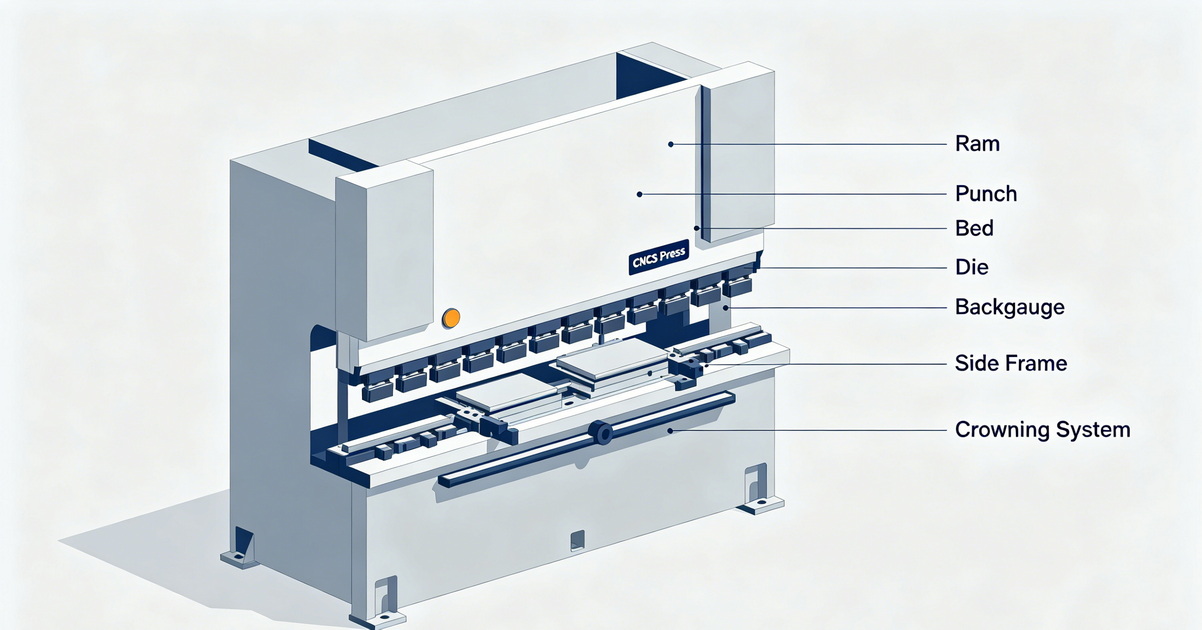
At its core, a CNC press brake is a precision machine tool that uses a punch, die and controlled force to bend sheet metal along a straight axis. Modern machines integrate mechanical components with a CNC system that coordinates movements along several axes. [youtube]
Key mechanical components:
- Ram (beam) – The moving upper beam holding the punch; travels vertically along the Y‑axis (often split into Y1 and Y2 for left/right control). [adhmt]
- Bed (table) – The fixed lower section where the die is mounted, sometimes equipped with a crowning system to compensate deflection. [printivity]
- Side frames (shoulders) – The vertical plates that define machine width and stiffness; the throat allows bending of wider sheets than the distance between the frames. [printivity]
- Backgauge – A programmable stop system that positions the sheet using multiple "fingers," moving in X (front/back), R (up/down), and Z (left/right) directions. [printivity]
The CNC system monitors and adjusts these elements in real time, ensuring that each bend angle and flange length matches the program, even when material thickness or hardness varies slightly from batch to batch. [adhmt]
From an engineering standpoint, how the ram is driven has major implications for energy use, speed, noise and maintenance. Most modern CNC press brakes use one of four main drive concepts:
- Hydraulic press brakes – Use oil‑filled cylinders to move the ram, offering high force and good control, especially for thick materials. They are robust but involve more valves, pumps and maintenance. [adhmt]
- Electric press brakes – Use ball screws and servo motors to drive the ram, providing high speed, excellent repeatability and lower energy consumption, but typically with lower maximum tonnage. [youtube]
- Servo‑hydraulic or hybrid press brakes – Combine hydraulic cylinders with servo‑controlled pumps to achieve higher energy efficiency and speed while retaining high force capacity. [adhmt]
- Mechanical legacy presses – Less common in new purchases; driven by flywheels and clutches, they offer high stroke rates but limited flexibility and safety compared to CNC systems. [youtube]
For many sheet metal shops, hybrid and modern hydraulic CNC press brakes remain the most cost‑effective balance of tonnage, accuracy and energy efficiency, especially when bending thicker carbon steel and stainless for industrial enclosures, HVAC, and machinery frames. [cnhawe]
When a press brake bends a long part, the frame and bed naturally deflect slightly, which can result in a bend that is tighter in the center and flatter at the ends. Crowning systems compensate for this, ensuring a consistent angle across the entire length of the bend. [printivity]
Common crowning approaches:
- Manual or mechanical crowning – Pre‑set wedges or mechanical systems that the operator adjusts according to material and length.
- Hydraulic crowning – Low‑flow, high‑pressure cylinders integrated into the bed generate counterforce in the center during bending, dynamically compensating deformation. [printivity]
In higher‑end CNC press brakes, the control can automatically calculate required crowning based on sheet thickness, length, tooling and programmed angle, reducing the need for manual trial‑and‑error. [adhmt]
Think of the CNC as the brain of the press brake: it converts your part drawing and bend sequence into precise axis movements and pressure control. On a modern machine, the workflow usually looks like this: [printivity]
1. Programming – The operator imports or draws a 2D/3D part, defines material, thickness and tools, and either manually or automatically generates a bend sequence. [adhmt]
2. Simulation and collision check – The CNC simulates each bend, checking for tool, backgauge and frame collisions, and optimizing the sequence when possible. [printivity]
3. Automatic calculation – The system calculates bending force, PMI (material parameters), crowning values and backgauge positions for each bend. [adhmt]
4. Execution – During production, the CNC coordinates Y1/Y2 ram movement and all backgauge axes, applying the correct pressure and depth to achieve the target angle.
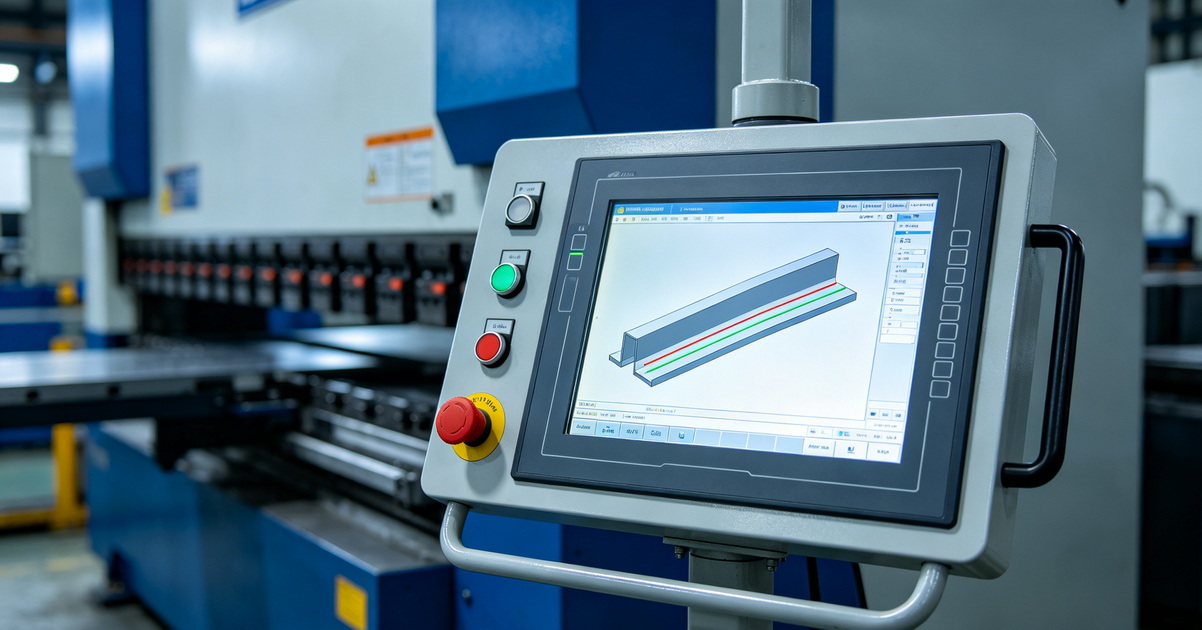
Advanced 3D controls with large multi‑touch screens (21" and beyond) allow operators to visualize the entire bending sequence, tooling layout and part orientation right on the machine, reducing setup errors and training time. [printivity]
From an application perspective, the bending method you choose directly affects required tonnage, tooling wear and angle accuracy. CNC press brakes commonly use three methods:
- Air bending – The punch does not bottom out; the sheet only contacts the punch tip and die shoulders. It requires less tonnage and provides flexible angle control but is more sensitive to material variations. [youtube]
- Bottom bending (bottoming) – The punch pushes the sheet into the die until it contacts the die angle; this produces a more consistent angle but uses higher force. [youtube]
- Coining – The punch penetrates deeper into the material, plastically deforming it along the full thickness; it delivers extremely accurate angles but with very high tonnage and more tooling wear. [youtube]
Most modern CNC press brake jobs use air bending for efficiency, switching to bottoming or coining only where tight tolerances or specific radii are required (for example in high‑precision brackets or safety‑critical components). [youtube]
To illustrate how a CNC press brake works in practice, consider a simple 90‑degree flange on a 3‑mm mild steel part:
1. The operator loads the program and confirms material, thickness and tool setup on the CNC screen. [adhmt]
2. The backgauge fingers move to the correct X and Z positions and R height based on the programmed flange length.
3. The operator slides the sheet against the backgauge and clamps it in position, either manually or via automatic sheet followers or robots. [youtube]
4. The ram descends at approach speed, switches to bending speed near the material, and applies the calculated force and depth to reach the target angle. [adhmt]
5. Angle sensors or spring‑back compensation logic help the CNC adjust depth for material behavior, ensuring consistent results from part to part. [adhmt]
6. The ram retracts, the backgauge moves to the next position, and the sequence repeats.
With proper tooling and programming, this process becomes fast, repeatable and safe, enabling small teams to run high‑mix, low‑volume jobs or multi‑shift production reliably. [youtube]
The VICLA article highlights how CNC press brakes are increasingly integrated into smart factories and automated cells, and this trend is accelerating globally. [printivity]
Key developments include:
- Real‑time monitoring and connectivity – Machines send production data (cycle counts, alarms, energy usage) to MES/ERP systems, enabling OEE dashboards and remote diagnostics. [cnhawe]
- Predictive maintenance – Vibration, temperature and pressure sensors feed analytics models that predict when components (pumps, valves, drives) need attention. [printivity]
- Robotic bending cells – Collaborative or articulated robots handle sheet loading, flipping and unloading, improving ergonomics and reducing repetitive strain on operators. [youtube]
For many shops, starting with offline programming and basic data connectivity provides immediate value without jumping straight into full automation. Manufacturers like CNDY‑Press and other global players now offer optional interfaces and kits to integrate press brakes into automated lines when the time is right. [prima-press]
Based on real buyer discussions, here is a concise selection checklist for your next CNC press brake:
- Bending length and tonnage – Match to your longest parts and thickest materials, with at least 20–30% safety margin. [prima-press]
- Frame stiffness and crowning – Check how the supplier verifies deflection and what crowning system is included for long parts. [printivity]
- Control and software – Evaluate screen size, 3D capabilities, offline programming options and ease of use for your team profile. [adhmt]
- Tooling system – Consider whether you need European, American or proprietary tool styles, quick‑change clamps, and existing tooling compatibility. [youtube]
- Service footprint – Confirm local partners, spare parts availability and response time SLAs before signing the PO. [blmamachinery]
A short site visit, including seeing similar machines in production at another customer, often reveals more about real‑world performance than any catalog spec sheet.
A widely known but seldom written‑about issue is tonnage and tooling mismatch between catalog data and real bending practice. On paper, a 160‑ton machine might look sufficient, but actual tooling selection, V‑opening and bending method can push your required tonnage far higher.
Inside shops, experienced operators sometimes "solve" this by slowing down the machine and accepting slight frame or tool deflection, which leads to inconsistent angles, premature tool wear and, in worst cases, permanent machine distortion. To avoid this:
- Ask your supplier to simulate your real parts, with chosen tools and materials, and share detailed tonnage and deflection reports. [prima-press]
- Insist on a run‑off with your own parts or representative samples before final acceptance of the machine.
- Document maximum recommended tonnage per meter for both the machine and each tool set, and train operators to respect those limits.
This kind of diligence is where a cooperative OEM/ODM manufacturer like CNDY‑Press can add genuine value, configuring both the machine and tooling to your specific part mix rather than just delivering a generic catalog configuration. [prima-press]
| Drive type | Typical use case | Strengths | Limitations |
|---|---|---|---|
| Hydraulic | Medium to heavy gauge bending | High force, mature technology. (adhmt) | More maintenance, higher energy use. (adhmt) |
| Electric | Thin to medium sheets, high precision | Very efficient, fast, low noise. (youtube) | Lower max tonnage. (youtube) |
| Servo‑hydraulic | Mixed thickness, energy‑conscious shops | Good force, better efficiency. (printivity) | Higher initial cost. |
| Mechanical | Legacy high‑stroke applications | High stroke rate. (youtube) | Limited flexibility, safety concerns. |
CNDY‑Press focuses on the R&D, manufacturing, sales and service of CNC press brakes and complementary sheet metal equipment, and regularly undertakes OEM and ODM projects for global partners. For buyers who need tailored solutions—whether that means special backgauge configurations, custom throat depth, or integration with existing automation—this kind of engineering flexibility can be decisive. [prima-press]
In practical terms, working with a manufacturer like CNDY‑Press allows you to:
- Customize machine capacity, control options and tooling to your part portfolio.
- Define project‑specific QC protocols at the factory, including extended testing or special inspections.
- Build a roadmap from standalone machines to semi‑ or fully automated bending cells as your volume grows.
A CNC press brake is more than a catalog spec; it is a long‑term production asset that directly shapes your delivery performance, quality reputation and operator safety. By understanding core components, drive technologies, bending methods and CNC control capabilities, you can make better decisions about tonnage, length, software and automation. [youtube]
If your team is planning a new machine purchase or considering an upgrade, start by documenting your current and future part mix, then engage with suppliers who can simulate those parts, propose realistic configurations and prove performance in real bending tests. To explore customized CNC press brake solutions, OEM/ODM projects, or integrated sheet metal lines, you can share your drawings, annual volumes and process requirements with the engineering team at CNDY‑Press and compare their proposal with your existing benchmarks. [prima-press]
Call to action: Prepare a short PDF with your typical parts, materials and required cycle times, and send it to CNDY‑Press along with your current machine data to receive a tailored CNC press brake configuration and ROI estimate.
1. How do I determine the required tonnage for my parts?
Use the standard bending tonnage formula based on material type, thickness, bend length and V‑die opening, then add a safety margin. Your machine supplier can simulate your parts with real tools to validate the numbers. [youtube]
2. What is the practical difference between a 2‑axis and multi‑axis backgauge?
A basic 2‑axis backgauge typically controls X and R, which is sufficient for simple flanges. Multi‑axis systems with Z1/Z2 and additional axes enable complex bend sequences, tapered parts and higher automation. [youtube]
3. How important is offline programming for a CNC press brake?
For high‑mix environments, offline programming allows engineers to prepare 3D bend sequences, simulations and tooling plans away from the machine, reducing downtime and setup time. It becomes critical when you have multiple machines or robotic cells. [adhmt]
4. Can older operators adapt easily to modern 3D CNC controls?
Most modern controls are designed with intuitive touch interfaces; with structured training and clear work instructions, experienced operators typically adapt faster than expected because they already understand bending fundamentals. [youtube]
5. When should I consider a robotic bending cell instead of manual operation?
Robotic cells make sense when you have stable part families, medium‑to‑high volumes, and repetitive handling that strains operators. If your mix is very high and volumes are low, start with connected CNC brakes and offline programming before investing in full automation. [youtube]
1. VICLA. "CNC Control System: How It Works On A Press Brake." [printivity]
2. ADH Machine Tool. "How Does a Press Brake Work? Drive Types, Tonnage, and Basics." [adhmt]
3. YouTube – ADH. "How Does A Press Brake Work?" [youtube]
4. YouTube – Press Brake Bending Basics. [youtube]
5. BLMA Machinery. "Top 10 CNC Press Brake Manufacturers in the World." [blmamachinery]
6. Shinite. "Top 10 Hydraulic Press Brake Manufacturers in World 2026." [shiniteknife]
7. CNHAWE. "9 Best CNC Hydraulic Press Brake Solutions for 2026." [cnhawe]
8. PrimaPress. "Hydraulic Press Brake & CNC Bending Machine." [prima-press]


