


Views: 222 Author: CNDY-Press Publish Time: 2026-04-20 Origin: Site


A CNC bending machine, often called a CNC press brake, is a computer‑controlled machine used to bend metal sheets into precise angles and complex profiles. It forms metal by pressing the sheet between an upper tool (punch) and a lower tool (die) to achieve a defined bend angle and internal radius. [tratfab]
Modern CNC sheet metal bending machines are now core equipment in:
- Automotive and commercial vehicles
- Construction and building hardware
- Electrical cabinets and enclosures
- Rail, shipbuilding, and aerospace components
- Renewable energy structures and frames [archivemarketresearch]
Compared with traditional mechanical brakes, a CNC press brake offers:
- Higher repeatability through precise CNC control of ram and backgauge positions [jugaocnc]
- Better energy efficiency via hybrid and servo‑hydraulic systems [accurl]
- Faster setup and changeover through programmable tooling and stored bending programs [slsmachinery]
From a manufacturer perspective at CNDY‑Press, we see customers moving from manual bending to CNC press brakes not just for accuracy, but to stabilize quality across multiple shifts and different operators. That is where the working principle and automation level really matter in daily production.

At its heart, the working principle of a CNC bending machine is simple:
1. The operator or engineer programs the bend sequence, angles, and dimensions in the CNC controller.
2. The controller moves the ram (upper beam) and backgauge to defined positions with high precision.
3. The upper punch presses the sheet into the lower die, forming the required angle and shape. [tratfab]
Behind these steps, several subsystems work together:
- CNC control unit – the "brain" that interprets the program and coordinates all axes. [jugaocnc]
- Hydraulic or servo‑hydraulic system – generates the pressing force for bending. [en.ysd-hd]
- Backgauge system (X/R and others) – positions the sheet accurately before each bend. [jugaocnc]
- Mechanical frame and ram – provide rigidity and precision during the bending cycle. [accurl]
- Tooling (punches and dies) – define the bend angle, radius, and profile. [en.ysd-hd]

Modern CNC press brakes usually control multiple axes, even on compact machines. Understanding these axes is essential to really grasp the working principle:
- Y1 / Y2 axes – independent control of the left and right side of the ram, ensuring parallelism and angle accuracy across the whole bending length. [jugaocnc]
- X axis – moves the backgauge forward and backward to set the flange length. [jugaocnc]
- R axis – adjusts the vertical height of the backgauge fingers, useful for multi‑step bending. [jugaocnc]
- Additional axes (Z1/Z2, X1/X2, etc.) – allow more complex positioning, segmented gauging, and high‑mix production flexibility. [jugaocnc]
By precisely synchronizing these axes, the CNC system compensates for material springback, tool deflection, and machine deformation, delivering consistent angles and dimensions even across long parts. [slsmachinery]
From an operator's standpoint on the shop floor, the CNC bending machine working principle becomes a concrete workflow:
- The part is designed in CAD, and the bending sequence is generated in CAM or directly on the CNC controller. [tratfab]
- Parameters such as material type, thickness, bending radius, bend allowance, and tooling are defined.
- The CNC then calculates ram depth, backgauge positions, and optimal sequence to avoid collisions and minimize re‑grips. [slsmachinery]
- The operator installs the required punch and die set, verifying correct clamping and alignment. [en.ysd-hd]
- The machine performs a reference / homing cycle to return axes to origin. [accurl]
- Backgauge fingers are positioned according to the first bend, and sample bending is used to fine‑tune angles if necessary. [tratfab]
Once the setup is confirmed, a standard bending cycle looks like this:
1. Positioning – backgauge moves to target position, operator places the sheet against gauge fingers.
2. Clamping and descent – ram descends at high approach speed, then slows near the sheet for controlled bending. [slsmachinery]
3. Bending – CNC controls tonnage and ram depth to reach the programmed angle, often using real‑time angle control and crowning systems. [accurl]
4. Return and repositioning – ram returns, backgauge moves to the next position, and the sequence continues until all bends are completed. [tratfab]
- Parts are checked for angle, flange length, and flatness; corrections are made directly at the CNC. [tratfab]
- For series production, the validated program is saved under a part name for quick future recall. [slsmachinery]
From years of working with OEMs and new buyers, one pattern is clear: most bending accidents are preventable. Below is a concise, expert‑level safety checklist adapted and expanded from standard practice and manufacturer guidelines. [senfenglaserusa]
Before starting:
- Inspect power and grounding – ensure supply, motor, and grounding are normal; verify the main switch and emergency stops. [senfenglaserusa]
- Check tooling – upper and lower molds must be correctly seated, overlapped, and firmly clamped before processing. [en.ysd-hd]
- Run a dry test – perform 1–3 minutes of dry‑run at full stroke to detect abnormal sounds, vibrations, or axis errors. [senfenglaserusa]
During operation:
- Assign one person as the lead operator/commander, others follow clear hand signals or HMI prompts. [shen-chong]
- Keep hands, body, and clothing away from the tooling zone; never reach between punch and die while powered. [shen-chong]
- Do not stand directly behind the machine during operation to avoid risk from sheet kick‑back or component failure. [shen-chong]
- Secure the sheet to avoid sudden lifting that can injure nearby personnel, especially with large or thin sheets. [senfenglaserusa]
After operation:
- Cut off the power when changing tooling or adjusting the sheet. [senfenglaserusa]
- When finishing, place wooden blocks under the cylinders and on the lower die, then lower the ram onto them for safe resting. [accurl]
For new operators, we recommend formal training, structured supervision, and a written checklist on the press brake itself. This single habit dramatically reduces startup issues and downtime.
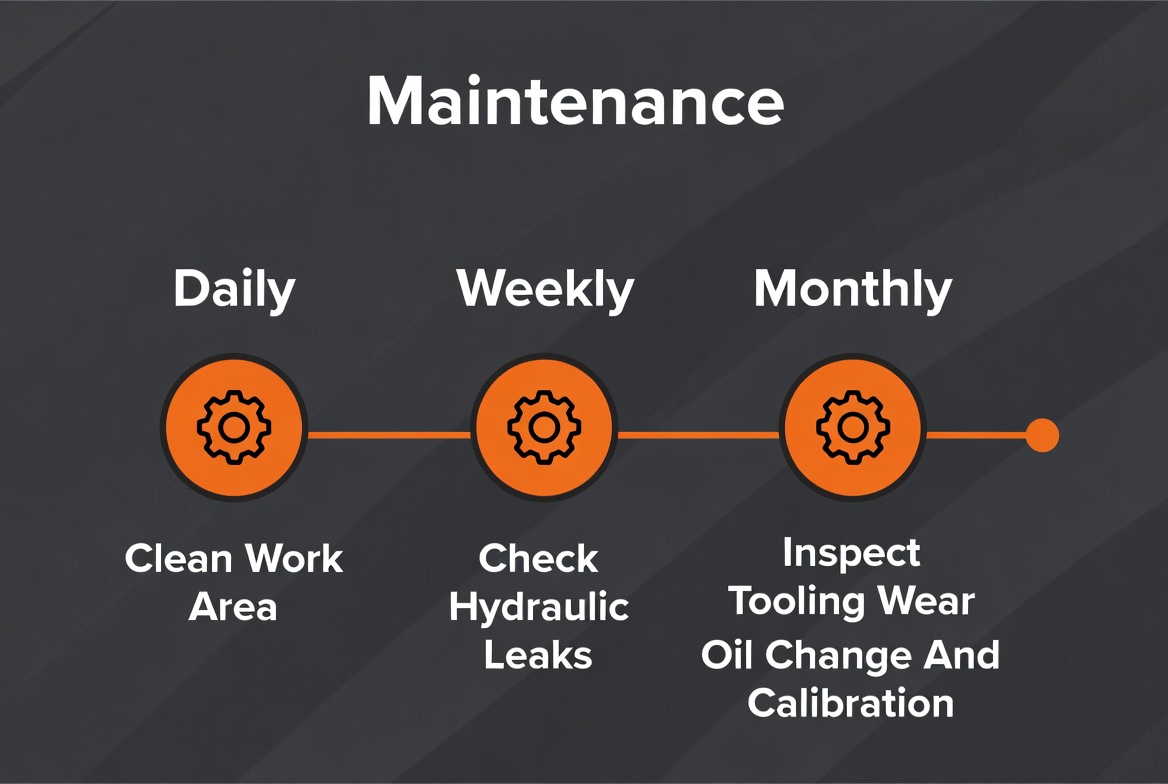
A CNC bending machine is a long‑term investment; how you maintain it determines its real lifetime cost. Daily and scheduled maintenance are non‑negotiable if you expect reliable accuracy and safety. [shop.adhmt]
Daily maintenance tasks: [sfcnclaser]
- Clean the work area and remove metal offcuts and dust.
- Inspect hydraulic hoses, fittings, and the cylinder area for leaks.
- Check fasteners and guards; confirm all safety devices work correctly.
- Verify lubrication levels and apply grease or oil to specified moving parts.
- Observe the machine during operation for unusual noise, heating, or vibration.
Weekly / monthly checks: [shop.adhmt]
- Inspect the hydraulic oil condition and temperature; change according to manufacturer guidance.
- Check ram parallelism and backgauge alignment; calibrate if necessary.
- Examine tooling for wear, damage, and burrs that could affect bend quality.
- Review CNC error logs and backup critical programs.
Best practices from real shops: [sfcnclaser]
- Keep a maintenance logbook with dates, findings, and actions taken.
- Standardize on quick‑change tooling to reduce setup time and limit operator error.
- Provide ongoing training so new staff understand not just "how" but "why" each maintenance step matters.
These steps are simple but are exactly what separate high‑availability bending cells from constantly troubled lines.
For buyers planning investments over the next 5–10 years, it is important to see where the CNC press brake industry is heading, not just how current machines work.
Recent market analyses show that the CNC press brake machine market is growing steadily, driven by: [linkedin]
- Increasing automation and labor shortages in fabrication shops
- Integration with Industry 4.0 and smart manufacturing (sensors, data analytics, predictive maintenance)
- Rising demand for high‑precision metal forming in automotive, renewable energy, and construction industries
One study expects the CNC press brake market to grow at around 5% CAGR between 2026 and 2033, highlighting strong demand for advanced control systems, automation, and connectivity. [linkedin]
For manufacturers like CNDY‑Press, this translates into:
- More machines with hybrid eco functions to reduce energy consumption and noise [archivemarketresearch]
- Deeper integration with factory MES/ERP systems and robotic loading/unloading cells [linkedin]
- Smarter angle control and adaptive crowning to reduce trial bends and scrap [accurl]
If you are evaluating a new CNC press brake, it is wise to consider not only current capacity but also which Industry 4.0 features you might need in 3–5 years.
When users contact us at CNDY‑Press or share feedback, their main concern is rarely "how many axes?" but "will this CNC bending machine really fit my work?". Industry practice suggests matching press brakes to applications like this: [archivemarketresearch]
| Typical application | Recommended CNC press brake type | Why it fits |
|---|---|---|
| Simple brackets, panels, low mix, thin sheets | 3–4 axis economic CNC hydraulic bending machine (accurl) | Low cost, sufficient automation, good for repetitive simple parts. |
| General job shops with mixed thickness and geometry | 4–6 axis Euro‑style CNC press brake (accurl) | More axes and better backgauge flexibility for varied parts and moderate complexity. |
| High‑precision, complex, multi‑bend components | 6–8 axis advanced CNC sheet metal bending machine with hybrid eco function and active angle control (accurl) | Handles complex sequences, multiple re‑positions, and tight tolerances while saving energy. |
When planning capacity, consider:
- Maximum sheet length and thickness you will bend
- Typical materials (mild steel, stainless, aluminum) and tolerance demands
- Required changeover frequency and operator skill level
- Need for future robotic or automatic tool change integration [archivemarketresearch]

To make the CNC bending machine working principle more concrete, imagine a fabrication shop producing electrical cabinet doors:
1. Programming: Engineer selects the cabinet door model, and the CNC automatically loads bend sequences and tools.
2. Setup: Operator mounts a segmented punch and V‑die, runs a dry cycle, and checks angle on a sample.
3. Production: Sheets come from a laser cutting machine, operator positions them against backgauge fingers, and the CNC press brake executes 6–8 bends automatically.
4. Quality control: Every 20–30 pieces, an operator checks dimensions; minor corrections are made in the CNC to compensate for coil batch variations.
5. Data collection: Production time and scrap rate are logged via networked CNC for later analysis. [archivemarketresearch]
This integrated workflow is increasingly standard, especially in export‑oriented factories and OEM suppliers.
For teams onboarding new operators, we recommend a simple laminated checklist placed next to the machine. It should cover:
1. Pre‑start safety checks (power, emergency stops, guards, tooling).
2. Daily cleaning and lubrication points.
3. Standard bending parameters for common materials (e.g., mild steel 3 mm, stainless 2 mm).
4. When to stop and call a supervisor: unusual noise, oil leakage, repeated angle errors, or CNC alarms.
This checklist approach is echoed in many training guides, where familiarity with manual, professional training, correct parameter settings, and documentation of bending tasks are stressed as core best practices. [sfcnclaser]
If you are evaluating a CNC bending machine or CNC press brake right now, the key is to align machine capability with your real production needs and growth plan.
As an OEM manufacturer, CNDY‑Press supports:
- OEM and ODM projects where the press brake must integrate into existing lines or unique automation setups.
- Customized CNC press brake configurations (tonnage, length, axes, controls) aligned with your parts and workflows.
- Application‑driven consulting, where we analyze your drawings, material mix, and expected volumes to recommend a realistic, future‑proof bending solution.
You can share sample drawings and annual volume data with our engineering team to receive a tailored CNC press brake proposal and bending solution roadmap.
1. What is the difference between a CNC bending machine and a conventional press brake?
A conventional press brake relies heavily on operator skill for angle accuracy, while a CNC bending machine uses programmed control of ram and backgauge axes to deliver higher repeatability, shorter setup time, and better integration with digital workflows. [slsmachinery]
2. How accurate is a modern CNC press brake?
With properly calibrated Y1/Y2 axes, crowning, and quality tooling, modern CNC press brakes routinely hold bending angles within a few tenths of a degree and flange lengths within tenths of a millimeter on stable material batches. [tratfab]
3. What types of materials can a CNC bending machine process?
Typical materials include mild steel, stainless steel, aluminum, and coated steels, provided the machine tonnage, tooling selection, and radius are correctly matched to thickness and tensile strength. [accurl]
4. How often does a CNC press brake need maintenance?
Basic cleaning, inspection, and lubrication should be done daily; more detailed inspections, hydraulic checks, and calibrations are usually scheduled monthly or quarterly depending on usage intensity and manufacturer recommendations. [shop.adhmt]
5. Is a CNC press brake suitable for low‑volume or prototype work?
Yes. Although often associated with mass production, modern CNC press brakes with intuitive controls and quick‑change tooling are ideal for prototypes and short runs because they reduce the trial‑and‑error normally required for complex bends. [slsmachinery]
1. Accurl – "CNC Bending Machine Working Principle."
https://www.accurl.com/blog/cnc-bending-machine-working-principle/ [accurl]
2. SLS Machinery – "How CNC Bending Machines Work: Precision in Metal Fabrication."
https://www.slsmachinery.com/News/how-does-a-cnc-bending-machine-work.html [slsmachinery]
3. JUGAO CNC – "Function and Working Principle of Bending Machine Axis."
https://www.jugaocnc.com/blog/function-and-working-principle-of-bending-machine-axis [jugaocnc]
4. YSD – "Working Principle and Use Method of CNC Bending Machine."
https://en.ysd-hd.com/news_details/1300515842918162432.html [en.ysd-hd]
5. TRATFAB – "How Does CNC Metal Bending Work?"
https://tratfab.com/tratfab-blog/how-does-cnc-metal-bending-work [tratfab]
6. Archive Market Research – "CNC Press Brake Analysis Report 2026: Market to Grow by a CAGR …"
https://www.archivemarketresearch.com/reports/cnc-press-brake-470130 [archivemarketresearch]
7. LinkedIn – "North America CNC Press Brake Market Size 2026."
https://www.linkedin.com/pulse/north-america-cnc-press-brake-market-size-2026-demand-gg4dc [linkedin]
8. LinkedIn – "Analyzing the CNC Press Brake Machine Market: Expected CAGR …"
https://www.linkedin.com/pulse/analyzing-cnc-press-brake-machine-market-expected-sziee [linkedin]
9. ADH – "Ultimate Guide to Press Brake Maintenance and Repair."
https://shop.adhmt.com/ultimate-guide-to-press-brake-maintenance-and-repair/ [shop.adhmt]
10. SFCNCLaser – "10 Tips for Beginners on Operating CNC Press Brakes."
https://www.sfcnclaser.com/10-tips-for-beginners-on-operating-cnc-press-brakes.html [sfcnclaser]
11. Senfeng USA – "10 Tips for Green Hands to Operate CNC Press Brakes."
https://www.senfenglaserusa.com/news/10-tips-for-green-hands-to-operate-cnc-press-brakes/ [senfenglaserusa]
12. Shen‑Chong – "Comprehensive CNC Press Brake Operation Guide."
https://www.shen-chong.com/zh/comprehensive-cnc-press-brake-operation-guide/ [shen-chong]
13. YouTube – "The Working Process of CNC Hydraulic Bending Machine."
https://www.youtube.com/watch?v=LWGKUUIMgaM [youtube]
14. YouTube – "The Basic Guide to Bending Machine."
https://www.youtube.com/watch?v=HwbeorHbeCI [youtube]


