


Views: 236 Author: CNDY-Press Publish Time: 2026-07-04 Origin: Site


Content Menu
● What Do "4-Axis" And "6-Axis" CNC Press Brakes Actually Mean?
● Core Capabilities Of A 4-Axis CNC Press Brake
● Where A 6-Axis CNC Press Brake Changes The Game
● Technical Comparison: 4-Axis vs. 6-Axis CNC Press Brake
● Do You Really Need The Extra Axes? A Framework
● Case Snapshot: Standard Fabricator vs. High-Mix OEM Cell
>> Scenario 1 – Standard fabricator
>> Scenario 2 – High-mix OEM/ODM cell
● Operator Experience: How Extra Axes Change Daily Work
● Hidden Costs: Setup Time, Scrap, And Changeovers
● Integration With Automation And Bending Cells
● How CNDY-Press Helps You Decide
● FAQ
If you mostly bend simple, repeatable parts, a 4-axis CNC press brake is usually enough; but if you run complex, asymmetrical parts or frequent changeovers, a 6-axis CNC press brake can pay for itself in flexibility and reduced setup time. The question is not "Is more always better?" but "Does your current and future part mix really need the extra axes?" [prima-press]
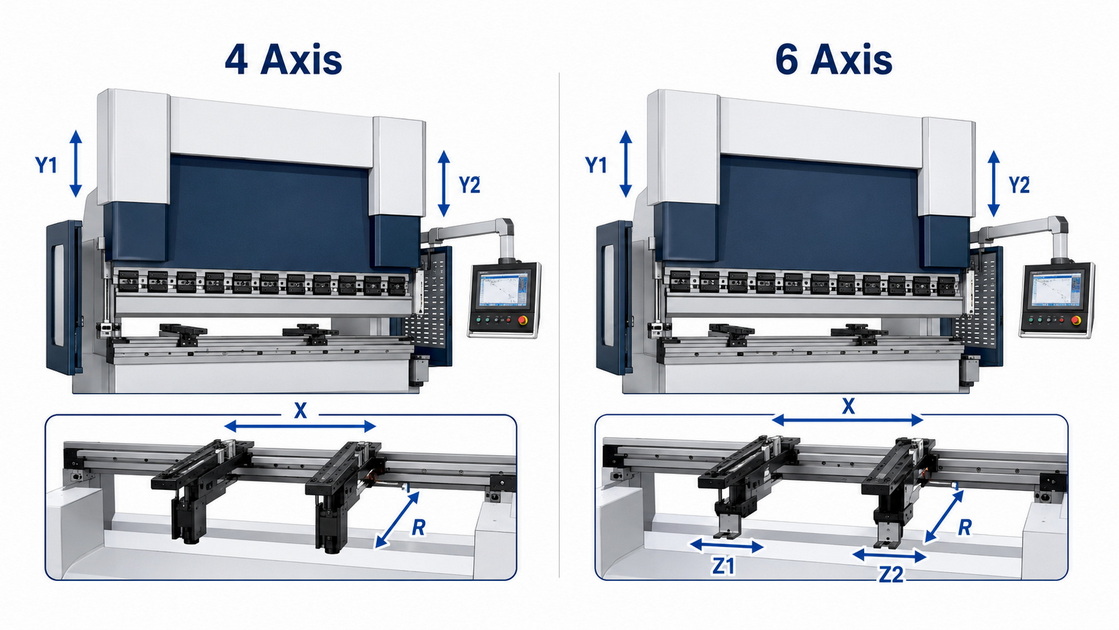
On a typical CNC press brake, the axes describe how the ram and backgauge can move under CNC control. Understanding this is the foundation for choosing between a 4-axis and 6-axis CNC press brake. [harsle]
- 4-axis CNC press brake
- Y1, Y2: Independent control of the left and right ram cylinders
- X: Backgauge depth (front–back)
- R: Backgauge height (up–down) [jsragos]
- 6-axis CNC press brake
- Y1, Y2, X, R as above
- Z1, Z2: Left and right backgauge fingers move side-to-side independently [lzkcnc]
In simple terms, a 4-axis press brake positions the backgauge in depth and height; a 6-axis press brake also changes the lateral position of each gauge finger independently, which dramatically helps with asymmetrical and multi-stage bending. [prima-press]
A 4-axis CNC press brake is considered the industry workhorse for general sheet metal fabrication. [jsragos]
Typical strengths:
- Handles straightforward bends with parallel flanges and consistent profiles
- Ideal for 90-degree bends, simple channels, U-shapes, and panels [prima-press]
- Offers good accuracy and repeatability for standard parts when combined with a modern CNC and quality tooling [huxleydesign]
- Simpler to program and operate, which lowers training time and reduces the risk of programming errors [lzkcnc]
For shops producing large volumes of similar parts with minimal variation, a 4-axis machine often delivers the best cost-to-productivity ratio. [lzkcnc]
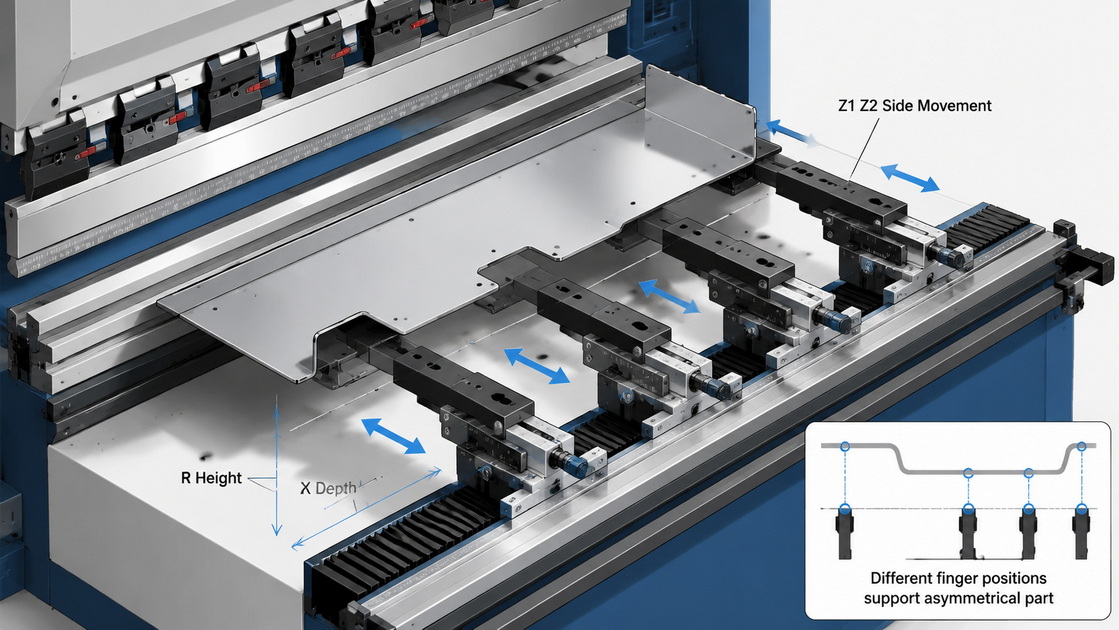
A 6-axis CNC press brake builds on this foundation by adding Z1 and Z2 backgauge axes, enabling independent side-to-side positioning of the gauge fingers. [reddit]
This brings key advantages:
- Asymmetrical bends: Easily support parts where flanges or profiles are not mirrored without flipping the sheet. [jsragos]
- Complex, multi-step bending: Run multiple bends in one setup by repositioning gauge fingers without manual adjustment. [amprodmfg]
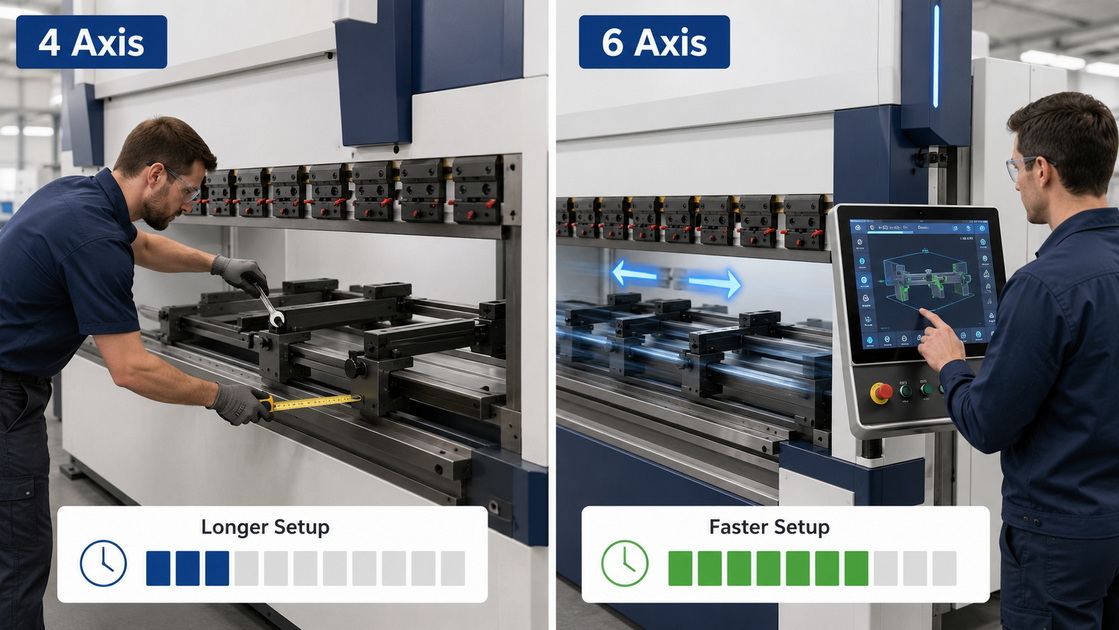
- Shorter setup times: Reduce or remove the need to mechanically move and re-align backgauge fingers between jobs. [prima-press]
- Higher precision on tricky parts: Fine-tune each gauge finger individually to support irregular shapes. [jsragos]
In high-mix, low-volume environments—particularly contract manufacturing and OEM/ODM jobs—this flexibility often translates directly into higher usable machine hours and fewer operator-induced errors. [amprodmfg]
| Feature / Aspect | 4-Axis CNC Press Brake (Y1, Y2, X, R) | 6-Axis CNC Press Brake (Y1, Y2, X, R, Z1, Z2) |
|---|---|---|
| Backgauge depth and height | CNC‑controlled X and R (prima-press) | CNC‑controlled X and R (prima-press) |
| Side‑to‑side finger movement | Fixed gauge spacing | Independent Z1 and Z2 axes per finger (prima-press) |
| Ideal part types | Simple, symmetric, parallel flanges (prima-press) | Asymmetrical, complex, multi‑flange parts (prima-press) |
| Setup time | Longer when changing gauge spacing manually (prima-press) | Faster job changeovers via CNC Z‑axis control (prima-press) |
| Programming complexity | Easier for new operators (prima-press) | Higher CNC programming demand (prima-press) |
| Upfront cost | Lower initial investment (prima-press) | Higher due to extra axes and hardware (prima-press) |
| Typical users | General fabrication, standard panels | High‑mix job shops, OEM/ODM, complex enclosures (jsragos) |
From a practical, expert perspective, the decision depends on your part portfolio and business model, not on the technology alone. [lzkcnc]
Ask yourself:
1. How complex are your typical parts?
- Mostly rectangular brackets and simple channels → 4-axis is usually enough.
- Many asymmetrical parts, offset flanges, and multi-bend sequences → 6-axis becomes attractive. [prima-press]
2. How often do you change jobs?
- Long runs, few changeovers → 4-axis works fine.
- High-mix, short runs, frequent setups → 6-axis cuts setup time and reduces manual adjustments. [amprodmfg]
3. What is your operator skill level?
- Limited CNC expertise in-house → 4-axis is easier to train and manage.
- Strong CNC press brake operators or willingness to invest in training → 6-axis potential is easier to realize. [jsragos]
4. What is your ROI horizon?
- Tight budget, short-term payback → 4-axis as a cost-effective workhorse.
- Long-term play for complex OEM/ODM contracts → 6-axis as a strategic, future-proof investment. [lzkcnc]
A regional fabricator produces standard panels, channels, and brackets for construction and agricultural equipment. Most parts are:
- Symmetric
- Made from a limited set of thicknesses and materials
- Manufactured in medium to long runs
In this case, a 4-axis CNC press brake with good tooling and a modern CNC controller typically meets all requirements with lower investment and simpler operation. [prima-press]
A contract manufacturer serving multiple OEMs runs:
- Frequent engineering changes
- Many asymmetrical enclosures, boxes, and welded assemblies
- Short to medium batches with tight delivery windows [amprodmfg]
Here, a 6-axis CNC press brake can:
- Run more complex sequences in one setup
- Reduce the need to flip or re-gauge parts
- Significantly reduce downtime between jobs [jsragos]
For CNDY-Press OEM/ODM customers, this second scenario is common—and a strong reason to consider 6-axis machines in key cells.
From the operator's perspective, a 4-axis CNC press brake is often more intuitive:
- Fewer axes to manage
- Simpler screens, fewer parameters
- Lower risk of misconfigured gauge positions [lzkcnc]
A 6-axis CNC press brake, however, can simplify the actual bending process once operators are trained:
- Programs can store complex gauge patterns, so operators follow clear prompts.
- Less manual repositioning of gauge fingers, spacers, or fixtures between jobs. [prima-press]
- Higher chance to run families of parts without reconfiguring hardware. [amprodmfg]
Well-designed CNC interfaces, clear work instructions, and structured training are crucial to help operators see the extra axes as an advantage, not a complication. [harsle]
When comparing 4-axis vs. 6-axis CNC press brakes, many buyers focus on the machine price. But experienced B2B buyers also look at:
- Setup time per job: Extra axes can pay off if you save minutes on every changeover. [jsragos]
- Scrap rate: More precise and flexible gauging can reduce first-off scrap and rework.
- Operator utilization: Less manual adjustment means operators can supervise more machines or focus on quality checks.
For high-mix manufacturers, the lifetime cost of lost time and scrap often exceeds the price difference between 4-axis and 6-axis machines. [amprodmfg]
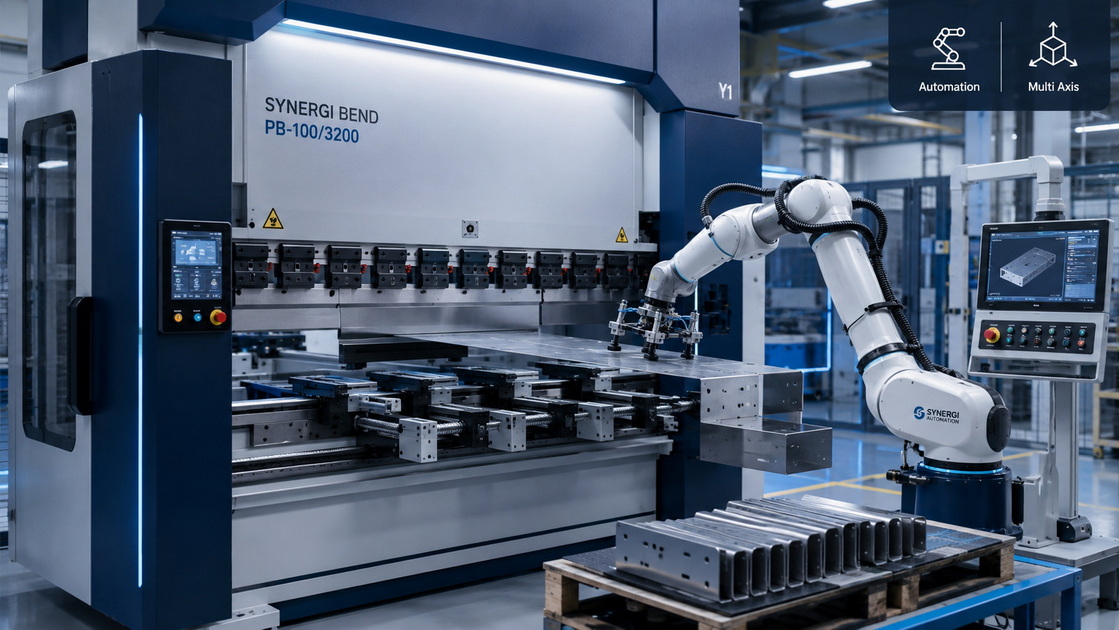
If you are planning robotic bending cells or advanced automation, extra axes become even more important.
- Robots benefit from predictable, programmable gauge positions, which a 6-axis backgauge provides more easily.
- Automated lines bending different part families in sequence need fast, fully CNC-controlled repositioning to avoid downtime between jobs. [youtube]
- Some integrators specifically recommend multi-axis backgauges when planning future cobot or robot upgrades.
Even if you are not automating today, a 6-axis CNC press brake can make future automation projects smoother, especially in OEM/ODM environments where part variety and complexity are expected to grow. [amprodmfg]
As a manufacturer focused on CNC press brakes and complete sheet metal processing systems, CNDY-Press approaches the 4-axis vs. 6-axis decision from your real production data, not just a spec sheet.
For OEM and ODM customers, we typically:
- Analyze your part drawings, material ranges, and batch sizes
- Map your current bottlenecks: long setups, scrap, operator overload
- Simulate how 4-axis and 6-axis configurations would handle your key parts
- Propose a tailored package: machine tonnage, bed length, axis configuration, tooling, and safety options
In many cases, a mixed strategy works best:
- 4-axis CNC press brakes as reliable workhorses for standard parts
- 6-axis CNC press brakes positioned in high-mix cells or new OEM/ODM projects
If you are planning to upgrade your press brake line or design a new OEM/ODM bending cell, now is the right moment to evaluate 4-axis vs. 6-axis CNC press brakes against your actual parts.
Share with CNDY-Press:
- A representative set of drawings (DXF/STEP)
- Materials and thickness ranges
- Typical batch sizes and changeover frequency
Our engineering team will help you determine whether you really need the extra axes, and if so, how to configure a CNC press brake solution that balances investment, flexibility, and long-term ROI for your sheet metal production.
1. What is the main difference between a 4-axis and 6-axis CNC press brake?
A 4-axis machine controls ram (Y1, Y2) and backgauge depth and height (X, R), while a 6-axis machine adds independent side-to-side movement for each gauge finger (Z1, Z2). [reddit]
2. When is a 4-axis CNC press brake enough?
If you mainly produce simple, symmetric parts with parallel flanges and run medium to long batches, a 4-axis CNC press brake typically covers your needs with lower cost and simpler programming. [prima-press]
3. Who really benefits from a 6-axis CNC press brake?
High-mix job shops and OEM/ODM manufacturers bending asymmetrical, complex enclosures and multi-stage parts gain the most, thanks to reduced setups, fewer manual adjustments, and more flexible gauge positioning. [lzkcnc]
4. Is a 6-axis CNC press brake harder to operate?
It requires more CNC understanding, but with good training and well-designed programs, operators often find it easier to run complex parts because the machine handles gauge repositioning automatically. [harsle]
5. How should I choose between 4-axis and 6-axis for my plant?
Analyze your part complexity, job-change frequency, operator skills, and automation plans, then compare the total cost of ownership—setup time, scrap, and future flexibility—not just the purchase price. [jsragos]
1. Prima Press – "4 Axis vs 6 Axis Press Brake — Which Should You Choose?"
https://www.prima-press.com/4-axis-vs-6-axis-press-brake-which-should-you-choose/ [prima-press]
2. HARSLE – "Understanding CNC Press Brake Machine Axes."
https://www.harsle.com/cnc-press-brake-machine-axes/ [harsle]
3. Huxley Design – "What Is a Press Brake: Revolutionizing Metal Fabrication."
https://huxleydesign.com/what-is-a-press-brake/ [huxleydesign]
4. js ragos – "4-Axis vs 8-Axis CNC Press Brake."
https://www.jsragos.com/4-vs-8-axis/ [jsragos]
5. LZKCNC – "4+1-Axis vs 6+1-Axis Press Brakes, Which One Is Better?"
https://www.lzkcnc.com/41-axis-vs-61-axis-press-brakes-which-one-is-better/ [lzkcnc]
6. American Products – "Press Brakes – Contract Manufacturing Equipment."
https://amprodmfg.com/capabilities-equipment/metal-enclosure-fabricating/press-brakes/ [amprodmfg]
7. Accurl – "Press Brake Applications: All Industries that Use Them."
https://www.accurl.com/blog/press-brake-applications/ [accurl]
8. Reddit r/Machinists – "Can someone please explain what the 4+1 axis and 6+1 axis in the press brake mean?"
https://www.reddit.com/r/Machinists/comments/1qccji6/can_someone_please_explain_what_the_41_axis_and/ [reddit]


