


Views: 265 Author: CNDY-Press Publish Time: 2026-09-25 Origin: Site


Content Menu
● What Is the Difference Between a Tandem and a Single Large Press Brake?
● How Does a Tandem Press Brake Work?
>> Key Advantages of Tandem Press Brakes
>> Tandem Press Brake Limitations
● What Is a Single Large Press Brake?
>> Key Advantages of Single Large Press Brakes
>> Single Large Press Brake Limitations
● Tandem vs. Single Large Press Brake: The Buying Decision Matrix
● Do Not Choose by Tonnage Alone
>> Why Load Distribution Matters
● Three Engineering Questions to Ask Before You Buy
>> 1. What Is Your Real Part Mix?
>> 2. Can Your Facility Handle the Machine?
>> 3. What Happens If Production Demand Changes?
● Recommended Configuration Options for CNDY-Press Buyers
● Which Press Brake Should You Buy?
● FAQ
>> 1. Can a tandem press brake bend long workpieces as accurately as a single large press brake?
>> 2. Does two 400-ton tandem press brakes equal an 800-ton press brake?
>> 3. Which option is better for bending light poles?
>> 4. Can I buy one press brake now and add a second machine later?
>> 5. Is a single large press brake easier to operate?
When a fabrication shop needs to bend sheet metal parts longer than 6 meters, the choice between a tandem press brake and a single large press brake can shape productivity, capacity planning, material flow, and maintenance risk for years. The right decision is not simply about maximum bending length or nominal tonnage—it depends on your part mix, required accuracy, load distribution, available floor space, operator capability, and future growth strategy.
For manufacturers of long products such as light poles, electrical enclosures, truck bodies, HVAC structures, elevator panels, agricultural equipment, steel doors, construction profiles, and energy-industry components, both configurations can be effective. However, they serve different production priorities.
At CNDY-Press, we support OEM and ODM sheet-metal equipment projects and develop customized CNC press brake solutions around the customer's drawings, materials, production rhythm, tooling requirements, and factory conditions. This guide explains how to evaluate tandem press brakes versus single large press brakes from an engineering, production, and total-cost perspective.
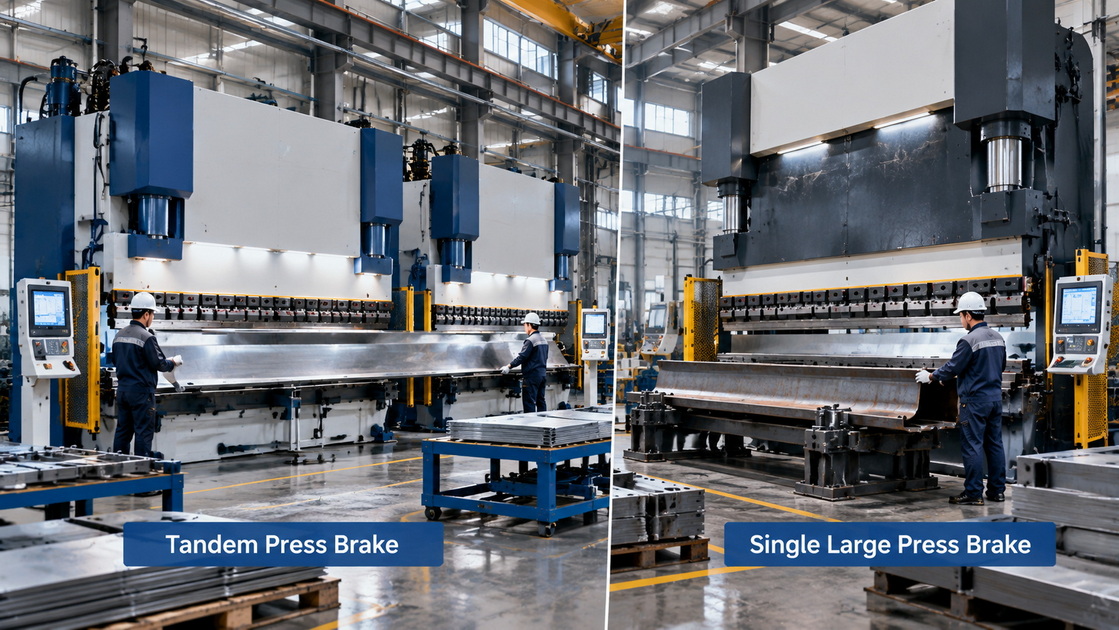
A tandem press brake system uses two compatible CNC press brakes installed side by side. In synchronized mode, both machines operate as one extended bending line for long workpieces. In independent mode, the two machines can bend separate short parts at the same time.
A single large press brake uses one long, rigid frame, one bed, one ram, and one unified CNC control system. It is purpose-built for long sheets, heavy plate, or large fabricated components that require continuous bending over an extended length.
The core distinction is simple:
- A tandem system prioritizes flexibility, modular capacity, and production redundancy
- A single-frame machine prioritizes structural continuity, simplified control, and dedicated long-part processing
Neither option is universally better. The best choice is the one that matches the way your shop actually works.
| Comparison Factor | Tandem CNC Press Brakes | Single Large Press Brake |
|---|---|---|
| Machine structure | Two synchronized machines | One continuous long frame |
| Long-part bending | Excellent when synchronized | Excellent for dedicated long parts |
| Short-part production | Strong; machines can work independently | Less efficient when short parts dominate |
| Production flexibility | Very high | Moderate |
| Control complexity | Higher because synchronization is required | Lower because one system controls one machine |
| Redundancy | Better; one machine may still run independently | Lower; one major failure can stop long-part work |
| Foundation and logistics | Often easier to transport and install | May require specialized transport, rigging, and site preparation |
| Precision potential | High with proper alignment and synchronization | High due to continuous-frame construction |
| Best fit | High-mix, variable-length, growth-oriented shops | Dedicated, repeatable, heavy-duty long-part production |
A tandem press brake consists of two CNC hydraulic, hybrid, or servo-electric press brakes configured to communicate as a coordinated system. Their ram movement, backgauges, safety devices, and bending programs are synchronized so that a long sheet can be bent across both beds.
For example, two 400-ton × 6-meter press brakes can be synchronized to bend a workpiece up to approximately 12 meters long. When the job requires shorter components, the machines can be separated and operated independently.
This dual-mode capability makes tandem systems particularly attractive for manufacturers with changing order volumes or diverse product sizes.
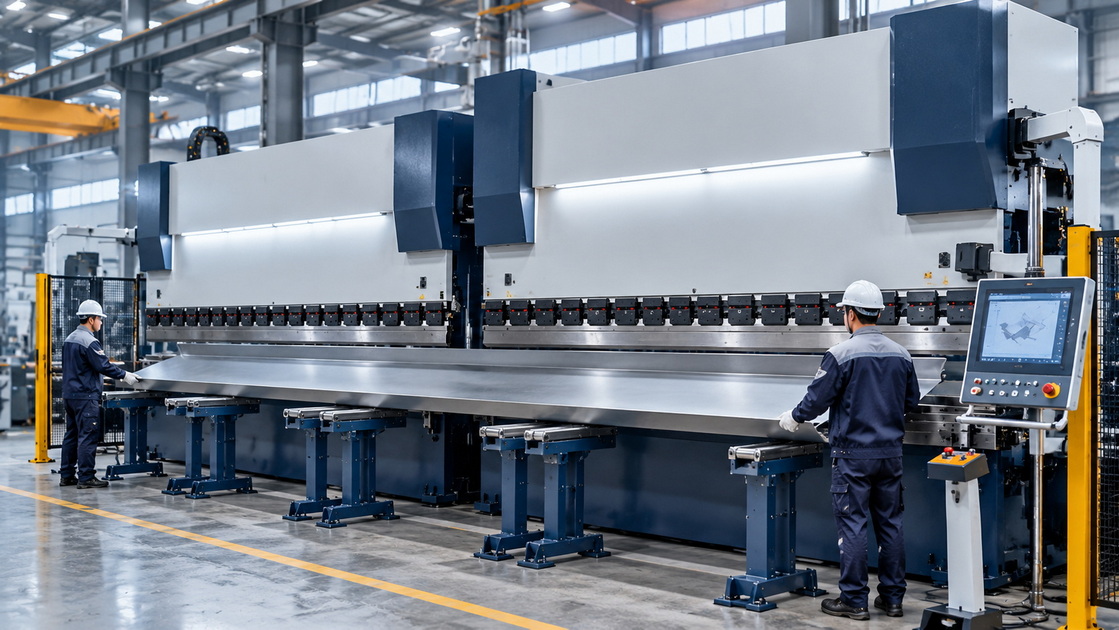
Flexible machine utilization. A tandem system can operate as one long press brake for oversized workpieces or as two separate machines for smaller parts. This helps prevent an 8-meter or 12-meter machine from being underutilized on 1-meter cabinet panels or brackets.
Higher practical uptime. If one machine needs service, the other machine may still be available for independent short-part production. This does not eliminate downtime for long-part jobs, but it can reduce the operational impact of maintenance.
Gradual capacity expansion. Some manufacturers purchase one press brake initially and add a compatible second unit when demand grows. This strategy can spread capital expenditure over time, although the first machine should be specified from the beginning with future tandem compatibility in mind.
More flexible factory layout. Two shorter machines may be easier to transport, position, and install than one ultra-long press brake. They can also offer more layout options in facilities with columns, restricted access, low ceilings, or limited rigging capacity.
Improved high-mix production. Shops that produce both long and short parts can schedule work more efficiently. One machine can process smaller components while both machines synchronize for a long-part order.
The main trade-off is synchronization complexity. A tandem system requires accurate mechanical alignment, matched machine specifications, compatible control systems, and reliable communication between the two machines.
Operators and maintenance teams must understand:
- Tandem-mode programming and calibration
- Ram synchronization checks
- Backgauge alignment across the full bending length
- Tooling setup consistency
- Machine leveling and bed alignment
- Emergency-stop coordination and safety-zone management
A tandem system is not simply "two machines placed next to each other." It must be engineered as a coordinated long-bed bending solution.
Importantly, buyers should not assume that two machines always provide double the usable tonnage for every job. Tandem capacity must be evaluated according to the bending length, load position, machine rating, tooling limits, and force distribution. A tandem pair is designed to distribute forming force over an extended bed; its capability should be verified for the specific bending application rather than estimated from nominal machine tonnage alone.
A single large press brake is a long-bed, heavy-duty machine designed around a continuous frame. It typically uses one extended ram, a unified hydraulic or servo-hydraulic system, and one CNC control platform.
This configuration is commonly selected for factories that consistently process large sheets, heavy plate, long structural components, or repeatable product families with a stable production profile.
CNDY-Press can configure large-format CNC press brakes for applications that demand extended bending length, high tonnage, customized stroke, deeper throat depth, specialized backgauges, heavy-duty tooling, and integration with material-handling or automation equipment.
One continuous structure. The uninterrupted machine frame can simplify long-part bending because the operator works with one bed, one ram, one control system, and one continuous tooling line.
Simplified daily operation. A single large press brake generally has fewer synchronization variables than a tandem setup. This can simplify programming, maintenance documentation, troubleshooting, and operator training.
Strong fit for repeatable production. If a factory repeatedly bends the same family of long components, a dedicated large press brake can create a straightforward workflow with consistent setup standards and material-handling routines.
Heavy-duty application capability. Large single-frame machines are often suitable for applications involving substantial tonnage, heavy plate, long structural bends, or production where the entire workpiece regularly occupies the full bed length.
Automation integration. For stable, high-volume jobs, a single large machine may offer a more centralized layout for robotic loading, automated tool changing, sheet support systems, angle measurement, and material transfer equipment. Modern press-brake automation systems are designed to improve efficiency and support complex tooling setups in repeat production environments.
The biggest limitation is reduced flexibility. A long dedicated machine can be inefficient when most jobs are short parts. It also creates a potential single point of failure: if the machine is down, all long-part bending capacity may stop.
A single large press brake may also require more planning for:
- Heavy-duty foundation conditions
- Long straight installation bays
- Large door openings and transport routes
- Overhead crane coverage
- Sheet loading and unloading space
- Long-part support systems
- Specialized rigging during installation or relocation
For large-format equipment, installation constraints can become as important as the machine specification itself.
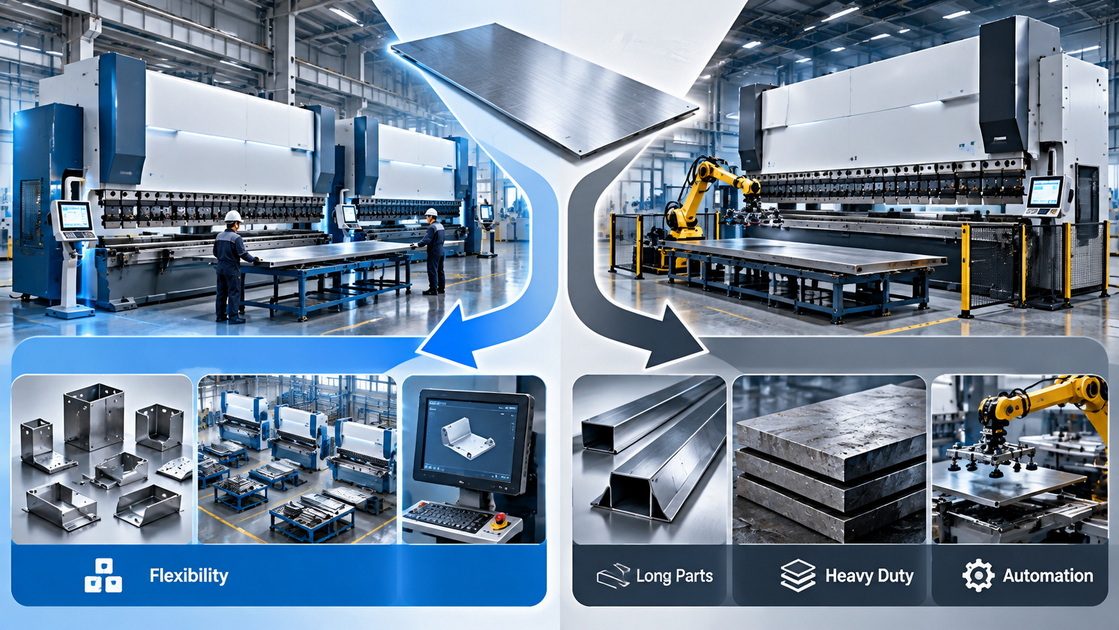
Use the following table as an early-stage screening tool. A final machine recommendation should always be based on actual part drawings, material grades, thickness ranges, tooling layouts, bend lengths, production volume, and factory conditions.
| Your Production Situation | Recommended Direction | Why |
|---|---|---|
| You bend both 2–4 meter parts and 8–12 meter parts | Tandem press brake | Two machines can run independently for short jobs and synchronize for long workpieces |
| You make the same long component repeatedly | Single large press brake | A dedicated continuous frame can simplify workflow and support repeatable production |
| You need built-in capacity redundancy | Tandem press brake | One machine may continue independent short-part production during maintenance on the other |
| You have limited access for oversized equipment delivery | Tandem press brake | Two smaller machines can be easier to transport and install |
| You bend heavy plate across a long, continuous length | Single large press brake | A single-frame heavy-duty design may better match dedicated high-force applications |
| Your shop expects changing product mix | Tandem press brake | Modular operation supports diverse part sizes and shifting demand |
| You prioritize the simplest operating process | Single large press brake | One machine and one CNC platform can reduce synchronization-related variables |
| You plan a dedicated automated long-part line | Single large press brake | A centralized machine layout may simplify workflow design for repeat work |
Many buyers focus too early on a machine's nominal press force, such as 400 tons, 800 tons, or 1,600 tons. Tonnage matters, but it is only one part of the engineering decision.
The actual force needed for a bend depends on multiple variables:
- Material type and tensile strength
- Sheet thickness
- Bend length
- V-die opening
- Punch radius
- Air bending, bottoming, or coining method
- Required inside bend radius
- Grain direction and material variation
- Tooling load rating
- Point load or center-load conditions
For air bending, required force rises significantly as material thickness increases, and it also increases with bending length. A commonly used calculation approach evaluates material thickness squared, bend length, die opening, tensile strength, and bending method.
The following practical rule is useful: a V-die opening around eight times the material thickness is often used as an initial reference for mild-steel air bending, but the correct die selection must still be verified according to the material, bend radius, tooling supplier guidance, and machine limits.
Imagine a manufacturer needs to bend a 10-meter-long steel profile.
A buyer may see two 400-ton press brakes in tandem and assume the system automatically provides 800 tons for every condition. That is not a safe purchasing assumption.
The engineering team must evaluate:
1. The actual tonnage required for the specific material and bend.
2. Whether the load is distributed across the full 10-meter bend length.
3. Each machine's allowable load over its working length.
4. Center-load and concentrated-load limits.
5. The punch, die, clamping, and crowning ratings.
6. Whether the bend line crosses the tandem junction correctly.
This is why an experienced manufacturer should review customer drawings before recommending a tandem or large single press brake.
Do not base the purchase only on the longest part you have ever produced. Review the last 12 months of production data and identify:
- The percentage of jobs under 3 meters
- The percentage of jobs between 3 and 6 meters
- The percentage of jobs over 6 meters
- Typical material thickness and material grades
- Average order size
- Frequency of setup changes
- Peak-season volume
- Expected new product categories
If 80% of your work consists of short parts and 20% requires long bending, tandem machines may offer a better utilization profile. If 90% of your work is repeat long-format fabrication, a dedicated large press brake may be the more efficient investment.
The machine footprint is only part of the space requirement. You also need space for raw material, operator movement, front support arms, lifting equipment, finished parts, tooling carts, maintenance access, and safe loading/unloading.
Before finalizing your layout, confirm:
- Door width and height for delivery
- Floor bearing capacity and foundation requirements
- Ceiling height and crane access
- Clearance at both machine ends
- Sheet staging area
- Forklift or crane travel paths
- Power supply and hydraulic-service requirements
- Future automation space
For a tandem system, alignment quality is especially important. The two machines must be leveled, positioned, and configured so their beds, rams, backgauges, and CNC movement operate as a coordinated system.
Capital equipment should support not only current orders but also reasonable future scenarios.
Ask whether your business may need:
- More short-part capacity
- Longer bending length
- Thicker materials
- Higher-strength steel processing
- More automation
- Additional shifts
- Faster setup changes
- Lower energy consumption
- OEM private-label machinery
- Custom throat depth, stroke, daylight, or backgauge travel
A tandem configuration often provides stronger adaptability. A single large press brake may be the better long-term choice when the factory's product range is stable and heavily concentrated in large components.
CNDY-Press can provide customized CNC press brake solutions based on OEM, ODM, and project-specific requirements. Instead of selecting a machine only from a standard catalog, buyers should specify the production result they need.
A complete project discussion should include:
- Maximum bending length
- Material types and maximum thickness
- Required bend angles and inside radii
- Annual output and shift pattern
- Required accuracy and repeatability
- Tooling type and quick-clamping preference
- CNC controller preference
- Backgauge axis requirements
- Crowning system requirements
- Safety configuration
- Energy-saving hydraulic or servo-hybrid requirements
- Automation or robotic integration plans
- Site installation conditions
For example, a customer producing long light-pole sections may prioritize synchronized tandem operation, full-length tooling, sheet-support systems, and long-part handling. A customer bending thick structural panels may prioritize a large single-frame press brake with higher tonnage, deeper throat depth, reinforced tooling, and a heavy-duty crowning system.
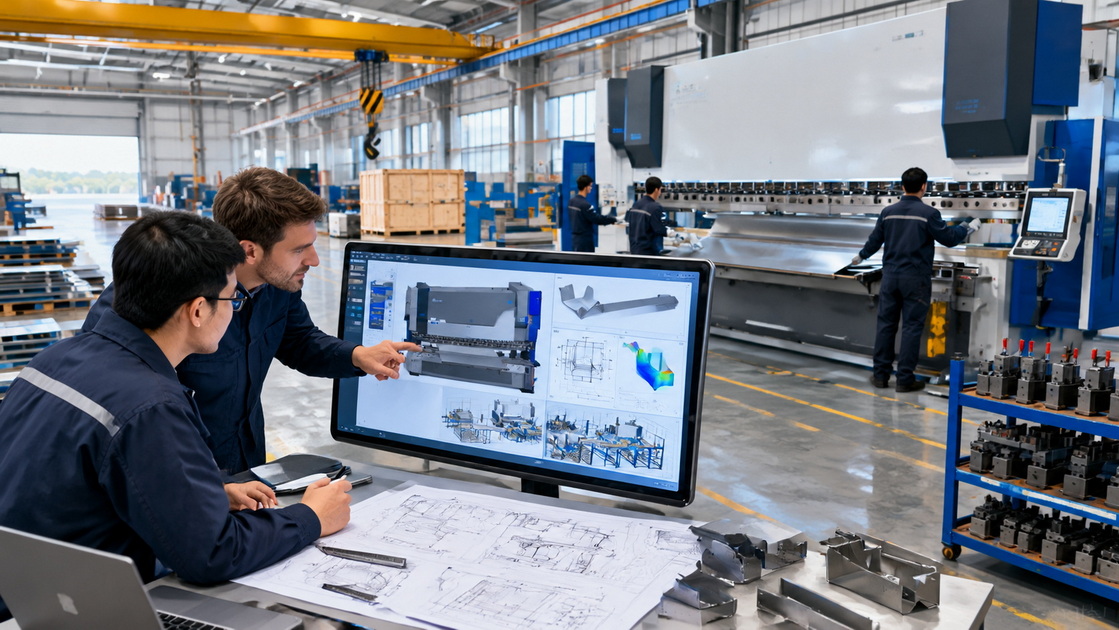
Choose a tandem press brake if your business needs long-part bending but also processes many short or medium-length components. Tandem systems are especially valuable for high-mix production, changing order patterns, limited installation access, staged capacity expansion, and improved operational flexibility.
Choose a single large press brake if your production is centered on repeatable long parts, heavy plate, dedicated large-format fabrication, simplified workflow, or centralized automation. A continuous large frame can provide a streamlined solution when long-part bending is the core of your manufacturing operation.
The most reliable way to make the decision is to compare both concepts using your actual drawings and production data—not generic tonnage figures or machine price alone.
Yes, a properly designed and calibrated tandem press brake can achieve high accuracy across long workpieces. However, it requires precise machine alignment, reliable CNC synchronization, compatible tooling, and regular calibration. A single large press brake has fewer synchronization variables because it uses one continuous frame.
Not in every bending condition. The usable forming capacity depends on load distribution, bending length, machine ratings, center-load limits, tooling ratings, and the position of the workpiece. Two tandem machines distribute force over a longer bed, but the application must be engineered correctly.
Tandem press brakes are often a strong choice for light-pole production because they can support long workpieces and may later run independently for shorter related parts. However, a single large press brake may be preferable for a factory dedicated exclusively to high-volume, repeatable long-pole production.
Yes, but this should be planned in advance. The first machine should be specified as tandem-compatible, with matching tonnage, bed length, stroke, control platform, hydraulic performance, safety configuration, and synchronization interface for the future second machine.
In most cases, yes. It uses one control system and one continuous frame, which can simplify setup and troubleshooting. Tandem systems are more flexible but require operators to understand synchronized operation and long-part alignment.
1. [CNDY-Press: Tandem Press Brakes vs Single Large Press Brakes—Which One Should You Buy?]
2. [The Fabricator: A Guide to Tandem Press Brakes]
3. [The Fabricator: Four Steps to Calculate Press Brake Tonnage Limits]
4. [Bystronic: Understanding Modern Press Brakes]
5. [RMFG: Press Brake Tonnage Chart and Calculator]


