


Views: 292 Author: CNDY-Press Publish Time: 2026-10-02 Origin: Site


Content Menu
● What Does a Control Retrofit Include?
>> The controller is only one part of the control loop
● When Is a Retrofit Worth Investigating?
● Inspect the Base Machine First
>> Hydraulic and electrical condition
● Safety Comes Before New Features
>> Record the machine's safe operating modes
● Choose the Upgrade Scope Around Real Jobs
>> Backgauge and axis upgrades
● Compare Retrofit and Replacement Costs Fairly
● Specify an Acceptance Test Before Ordering
● A Practical Retrofit Project Sequence
>> 1. Can I upgrade only the controller?
>> 2. Will a new CNC eliminate bend-angle variation?
>> 3. Does adding a light curtain make an old press brake compliant?
>> 4. Can a retrofit convert a hydraulic press brake into a servo-electric machine?
>> 5. What should be included in the retrofit warranty?
A press brake control retrofit and upgrade can extend the useful life of a mechanically sound machine. Replacing an obsolete controller may make programming easier, restore access to supported components, or enable suitable backgauge and diagnostic improvements. But a new screen cannot straighten a worn frame, repair inconsistent hydraulic motion, or make an unsafe installation acceptable. The decision starts with an engineering assessment of the entire press brake, not a controller catalogue.
For sheet-metal shops, the real question is whether a retrofit can produce repeatable, accepted parts at a sensible total cost. This guide explains what to inspect, what to include in the scope, how to measure results, and when a new CNC press brake may be the better investment. It is a purchasing framework, not a report of retrofit results achieved by CNDY-Press.

A basic retrofit may replace the CNC interface and related electronics while retaining the machine's frame, ram drive, tooling, and some positioning hardware. A broader upgrade can involve axis drives, encoders, electrical cabinets, backgauge components, hydraulic controls, software, and safeguarding. The final scope depends on the existing machine and the hazards identified during assessment.
This distinction matters because a supplier's quotation for "CNC upgrade" might include a controller but exclude wiring, axis calibration, safety integration, operator training, and recommissioning. Ask for a written boundary between retained, replaced, refurbished, and newly supplied components.
A contemporary controller can offer useful functions. For example, Delem's published DA-53T specification describes up to four axes, crowning control, tool and material libraries, and support for open- or closed-loop valve applications. Those are features of that controller; they do not establish that it can be installed successfully on every older press brake without other changes.
A bending programme sends commands to drives and valves. Sensors report position. Mechanical and hydraulic systems respond. If a ram-position sensor is unreliable or the hydraulic valves behave inconsistently, replacing the display may not fix the finished part.
Before choosing hardware, document:
- The existing ram and backgauge axes.
- Motor, valve, encoder, and linear-scale specifications.
- Available electrical drawings and service manuals.
- Tooling, crowning, and angle-measurement arrangements.
- Existing guarding, interlocks, and emergency-stop functions.
- Components whose manufacturers no longer provide support.
A retrofit integrator can then identify which interfaces remain usable and which must be replaced. This is more defensible than assuming that a named controller model is a direct plug-in replacement.
A retrofit is most promising when the machine's structural and forming capability still fits the shop's work but an obsolete control system causes downtime or restricts programming. Warning signs include unavailable controller parts, repeated programme-entry errors, unreliable backgauge positioning, or excessive time spent restoring familiar jobs.
Do not assume every bend-angle problem is caused by the CNC. Material variation, tooling wear, ram alignment, hydraulic drift, and poor setup can produce similar symptoms. Measure the machine before deciding which component is responsible.
| Current condition | Likely next step |
|---|---|
| Sound frame and hydraulics; obsolete controller with unsupported parts | Scope a control retrofit |
| Sound machine; recurring backgauge positioning fault | Diagnose drive, sensor, mechanics, and control together |
| Persistent ram inconsistency or hydraulic leakage | Repair and assess the base machine before pricing a controller |
| Capacity or working length no longer meets the part mix | Compare replacement or an additional machine |
| Safeguarding gaps or undocumented modifications | Complete a risk assessment before proceeding |
A repair may also be preferable to a retrofit. If a supported controller has one identifiable fault and the machine meets current production needs, replacing the failed component could cost less and disrupt production for less time. A buyer should request repair, retrofit, and replacement options using the same production requirements.
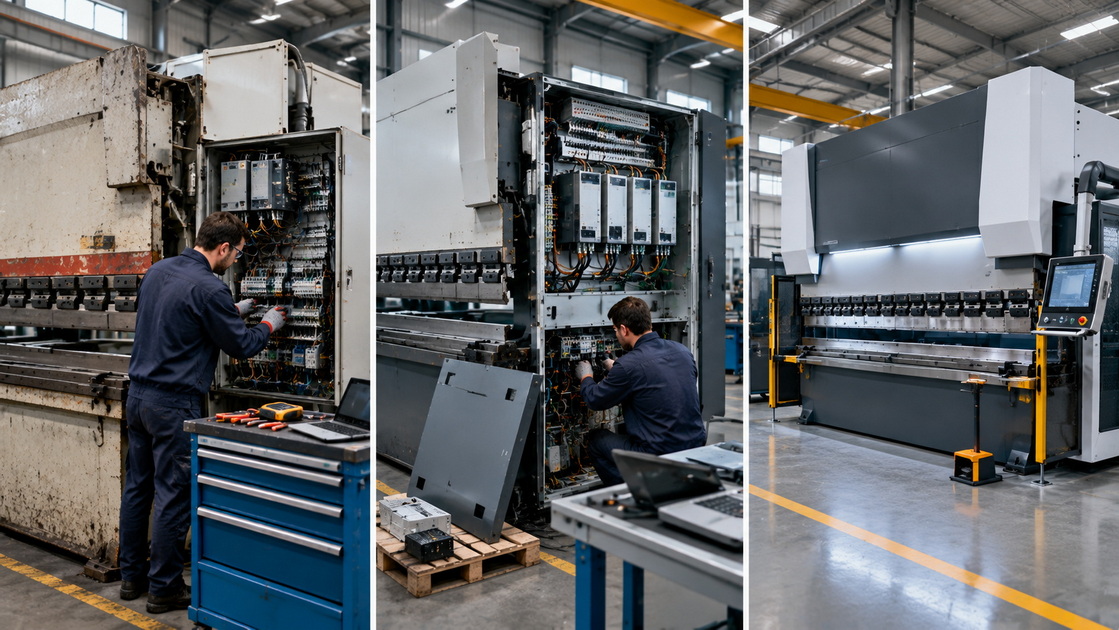
Check for visible damage, unusual deflection, worn guides, poor alignment, or a history of overload. Measure bend results on representative material across the left, centre, and right of the working length. A machine that cannot deliver stable results because of mechanical condition needs more than a new control panel.
Confirm that the press force, bending length, stroke, daylight, and tooling arrangement still suit the expected jobs. A retrofit should not be used to justify operating outside the original machine's verified limits.
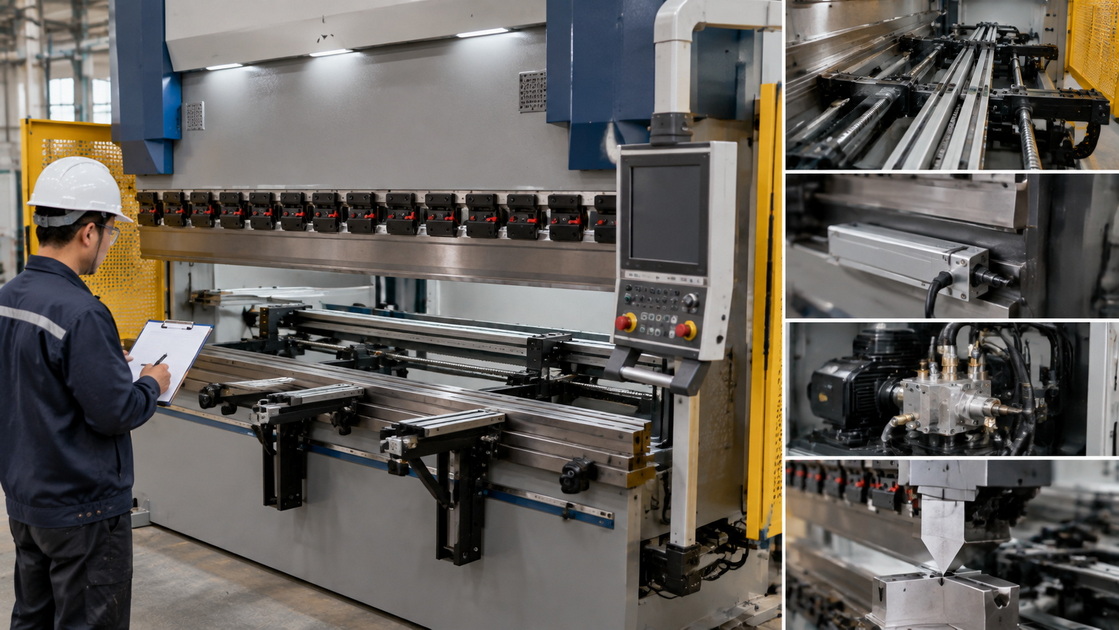
For a hydraulic brake, inspect cylinders, seals, valves, hoses, fluid condition, pressure behaviour, and the availability of replacement parts. On any drive type, review cabling, sensors, cabinets, grounding, and the condition of retained electrical hardware.
Record faults under normal production conditions, not only during an unloaded workshop demonstration. The machine may appear stable when idle and behave differently under a demanding bend.
Before soliciting quotes, record a baseline for several representative parts:
1. Time from programme selection to first accepted part.
2. Number of trial bends and adjustments.
3. Accepted parts per hour.
4. Bend-angle and flange-dimension variation.
5. Downtime attributable specifically to the control system.
6. Scrap and rework causes, separated by material, tooling, operator, and machine issue.
This prevents a common evaluation error: attributing every later improvement to the new controller, even when the project also included new tooling or extensive mechanical repairs.
A press brake retrofit changes a machine on which people work close to moving tooling and stock. OSHA identifies point-of-operation injuries, accidental cycling through operating controls, and movement of large workpieces among powered-press-brake hazards. Safeguarding must be assessed for the modified machine and its intended operating modes.
Do not purchase a laser guard or light curtain solely because its brochure names a safety category or response time. Confirm the entire safety function: device selection, placement, wiring, control logic, stopping behaviour, operating modes, bypass prevention, and testing. A safety-rated component does not, on its own, make the completed installation safe.
In the United States, servicing and maintenance that could expose workers to unexpected energisation or stored energy must be assessed against OSHA's lockout/tagout requirements. For machinery entering or substantially altered for the EU market, establish the applicable conformity obligations before work starts. The European Commission states that its new Machinery Regulation (EU) 2023/1230 becomes mandatory on 20 January 2027; the treatment of a particular modification depends on its facts and jurisdiction.
A retrofit specification should cover setup, tool change, normal bending, maintenance, and fault recovery. For each mode, identify which movements are permitted, who can enable them, and what stops or prevents hazardous motion.
If a proposed upgrade raises speed, adds automation, or changes how a guard interacts with the ram, reassess the resulting risks. Do not describe the machine as compliant merely because its new controller or protective device carries a mark or certificate. The European Commission cautions that voluntary certificates are not, by themselves, recognised proof of machinery conformity under applicable EU rules.
Ask what the operator needs from the control. For a high-mix job shop, clear programming, stored tool data, and programme retrieval may matter more than a visually elaborate interface. For repeated complex parts, bend-sequence support and offline preparation may be valuable.
Request a demonstration using your own part drawings. Ask the supplier to show how programs, tool libraries, parameters, and backups will be transferred or rebuilt. Confirm software support and the procedure for recovering from controller failure.
An extra axis is useful only when it addresses a real setup constraint. A wider backgauge upgrade may involve motors, drives, guideways, feedback devices, mechanical travel, wiring, and collision checks—not merely a controller setting. Determine whether the retained machine can physically support the proposed configuration.
Instead of specifying "six axes" because a brochure offers them, identify the parts that currently require manual gauge adjustment or repeated handling. Have the supplier show how the proposed axes would make those parts easier to produce.
Crowning can compensate for deflection along longer bends, but the method must fit the machine and tooling. Likewise, adding an angle sensor requires compatible controls, installation space, calibration, and a defined measurement process. A retrofit should be evaluated on finished-part results, not the number of optional functions on its screen.
The original article describes retrofit as a fraction of replacement cost and offers fixed productivity and energy-saving figures. Those results may be possible in an individual project, but they cannot be assumed from replacing the controller alone. In particular, a servo-electric drive and a modern CNC interface are different changes; a controller swap does not convert a hydraulic machine into an all-electric one.
Build a total-project-cost comparison instead:
| Cost or outcome | Retrofit proposal | Replacement proposal |
|---|---|---|
| Equipment and integration | Controller, drives, wiring, safety work, retained-machine repairs | New machine and specified options |
| Installation | Site work, commissioning, calibration | Delivery, installation, commissioning |
| Lost production | Planned shutdown and potential troubleshooting | Removal, installation, training, ramp-up |
| Capability | Limited by retained frame, force, length, and mechanics | Depends on selected new machine |
| Support | Responsibilities split unless contract assigns one integrator | Define supplier and local-service obligations |
| Acceptance | Test the modified complete machine | Test the delivered complete machine |
Then compare the cost per accepted part and the value of avoided downtime. A lower capital quotation may be unattractive if the retained machine has recurring hydraulic failures. A new machine may be excessive if one unsupported controller is the main problem.
Illustrative example: A shop's brake meets its force and working-length needs, but control-board failures repeatedly stop production. A retrofit could be rational if the frame, hydraulics, and safety systems pass inspection and the upgraded machine meets agreed part tests. If the same brake also has ram drift and insufficient capacity, a controller-only quote understates the investment required. This example is a decision scenario, not a documented CNDY-Press installation.
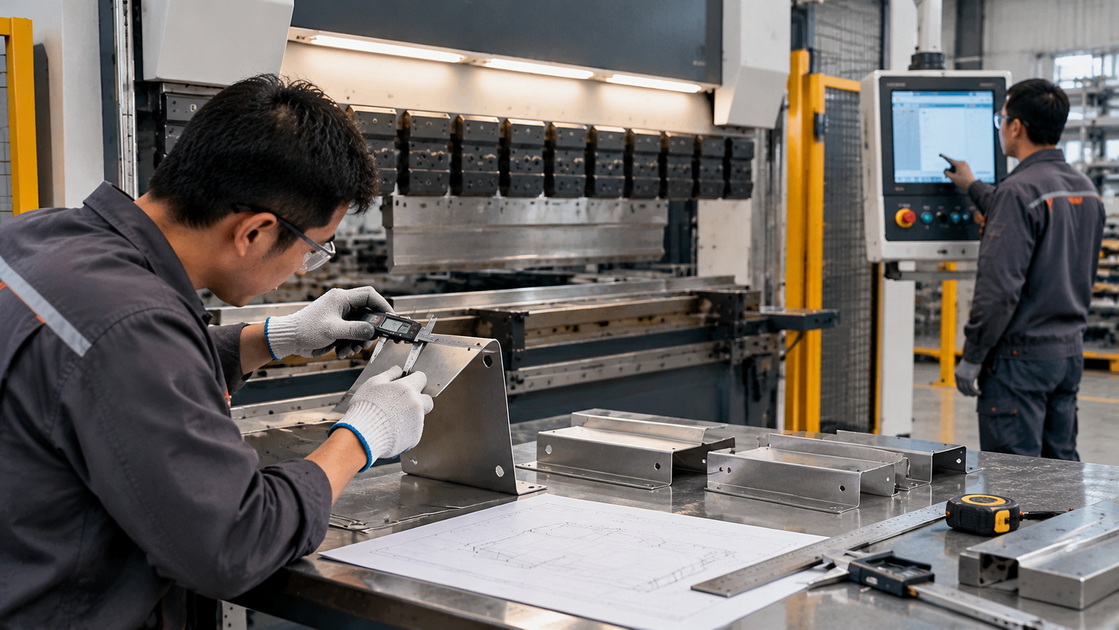
A retrofit quotation should state what success looks like. The commissioning team and buyer can then test the same requirements at handover. At minimum, the written plan should identify:
- Representative parts: material, thickness, bend length, tooling, and target dimensions.
- Measurements: locations on each part, number of parts tested, and agreed tolerances.
- Operation: first-part setup, programme recall, backgauge motion, and error recovery.
- Safety: documented checks of guards, stops, interlocks, and relevant operating modes.
- Documentation: updated electrical and hydraulic drawings, backups, parameter records, and instructions.
- Training: operator and maintenance instruction with named attendees.
- Support: warranty boundaries, spare-parts availability, and response arrangements.
A new controller's published positioning specification is not a finished bend-angle guarantee. Test with your material and your tooling. Keep the baseline measurements so improvements—and remaining limitations—can be reported honestly.
1. Define the production problem. Record actual control failures, setup losses, scrap causes, and unavailable components.
2. Audit the machine. Inspect mechanics, hydraulics, electrics, tooling, and safety; identify any conditions that make a controller-only retrofit unsuitable.
3. Agree on scope. List retained and replaced components, software, axis functions, guarding, drawings, and responsibilities.
4. Assess modification obligations. Review the rules applicable at the installation site and determine whether a new conformity assessment or other approval work is required.
5. Schedule downtime. Allow time for installation, fault finding, calibration, safety validation, and operator training—not merely physical fitting.
6. Run agreed acceptance tests. Use representative parts and document both finished-part results and unresolved issues.
7. Hand over maintainable equipment. Deliver backups, parameter lists, drawings, maintenance instructions, and service contacts.
Where multiple contractors are involved, name one party responsible for integration and handover. Otherwise, faults can fall between the controller supplier, safety-device installer, machine service team, and buyer.
CNDY-Press states that it develops, manufactures, sells, and services CNC press brakes and supports OEM, ODM, and customised equipment projects. A buyer assessing an ageing brake can send CNDY-Press the machine details and production brief for a retrofit-versus-replacement discussion. Whether CNDY-Press can perform a particular control retrofit, integrate specific third-party controls, or certify a modified machine must be confirmed in a project-specific proposal; those capabilities have not been independently established by this article.
Send CNDY-Press the machine make and model, year, controller and drive details, electrical drawings, fault history, five representative part drawings, destination country, and required shutdown window. Request two clearly scoped options where feasible: modernise the existing brake or specify a replacement CNC press brake, each with safety, acceptance, installation, and service responsibilities shown separately.
Sometimes. A controller-only change is plausible if the retained drives, sensors, hydraulics, mechanics, and safety functions are compatible and in suitable condition. A site assessment is necessary before treating it as a straightforward swap.
No. Control improvements cannot remove material variation, worn tooling, poor alignment, or hydraulic faults. Require a finished-part acceptance test rather than relying on controller positioning claims.
Not automatically. Its location, integration, stopping behaviour, operating modes, and the machine's other hazards must be assessed and tested as a system. Requirements depend on the installation jurisdiction.
A controller replacement alone cannot. Changing the principal ram drive would be a much wider engineering project involving mechanics, controls, and safety. Compare that scope with the cost and practicality of buying a suitable new machine.
Define coverage for the new controller, drives, wiring, safety integration, software, and commissioning work. State what remains the buyer's responsibility on the retained machine and who diagnoses faults involving both old and new components.
1. [CNHAWE, "Press Brake Control Retrofit and Upgrade: Complete Guide to Modernizing Your Bending Operations"] — Source article evaluated and restructured; its project results and performance percentages are not attributed to CNDY-Press. [cnhawe]
2. [Delem, "DA-53T Press Brake Control"] — Manufacturer specification for controller axes, libraries, crowning, and valve-control options. [delem]
3. [U.S. OSHA, "Machine Guarding: Powered Press Brakes"] — Official description of operating hazards and safeguarding approaches. [osha]
4. [U.S. OSHA, "The Control of Hazardous Energy: 29 CFR 1910.147"] — Requirements relevant to servicing and maintenance involving hazardous energy. [osha]
5. [European Commission, "Machinery"] — Current EU machinery framework, 20 January 2027 application date for Regulation (EU) 2023/1230, and cautions about voluntary certificates. [single-market-economy.ec.europa]
6. [ANSI, "ANSI B11.3-2022: Safety Requirements for Power Press Brakes"] — Overview of the U.S. machine-specific consensus standard. [blog.ansi]


