


Views: 268 Author: CNDY-Press Publish Time: 2026-10-04 Origin: Site


Content Menu
● What Is the Difference Between Hydraulic and Electric Press Brakes?
● Hydraulic vs Electric Press Brake Comparison Table
● When a Hydraulic Press Brake Is the Better Choice
>> Choose Hydraulic When You Need High Tonnage
>> Choose Hydraulic for Long Working Lengths
>> Choose Hydraulic When Initial Budget Is Critical
● When an Electric Press Brake Is the Better Choice
>> Choose Electric for High-Cycle, Repeatable Parts
>> Choose Electric When Energy Use and Shop Cleanliness Matter
>> Choose Electric When Oil-Free Operation Is Valuable
● The Tonnage Question: Do Not Use a Simple 300-Ton Rule
● Total Cost of Ownership: Compare Five Years, Not Only the Quote
>> A Simple Energy ROI Formula
● Accuracy Depends on the Whole Bending System
>> What Actually Controls Bend Accuracy
● Safety and Compliance: Evaluate the Complete Machine
>> Do Not Overlook Lockout and Stored Energy
● A Practical Buyer Decision Matrix
● The Underused Procurement Test: Measure Idle Power First
● Why CNDY-Press for Customized Press Brake Projects?
>> 1. Is an electric press brake always more accurate than a hydraulic press brake?
>> 2. Are hydraulic press brakes still suitable for modern fabrication shops?
>> 3. How can I calculate whether an electric press brake will pay back its higher price?
>> 4. What information should I send to a press brake manufacturer for an accurate quotation?
>> 5. What safety documents should be included with a CE-marked press brake?
Choosing between a hydraulic press brake and an electric press brake is not simply a question of which machine is newer. The right choice depends on your material range, required tonnage, part mix, bend accuracy, operating hours, energy cost, maintenance capability, safety requirements, and long-term expansion plan.
For many fabrication businesses, the most practical answer is not "hydraulic or electric." It is a clear understanding of where each drive system creates value. Hydraulic CNC press brakes remain highly relevant for heavy-duty, long-bed, and high-tonnage bending. Servo-electric press brakes can be a strong option for high-repeatability, thinner-gauge, high-cycle work where lower idle energy use, clean operation, and fast response justify a higher initial investment.
Procurement note: Machine specifications vary by manufacturer and configuration. Always compare the proposed press brake using your actual material grade, thickness, bend length, tooling, annual cycle count, electricity rate, and safety requirements—not a generic tonnage or "energy-saving" claim.

Both machine types bend sheet metal by moving a ram with a punch toward a die. The key difference is how that ram motion and bending force are generated.
A hydraulic press brake uses hydraulic cylinders, a pump, valves, piping, fluid, and a control system to drive the ram. Modern electro-hydraulic CNC machines often use independent cylinders and linear encoders to control ram synchronisation and bending accuracy.
Hydraulic press brakes remain common because they can support:
- High bending forces
- Long working lengths
- Large daylight openings
- Deep throat depths
- Heavy or variable-gauge work
- Broad tooling choices
- Tandem-machine applications
- Widely available service knowledge
An electric press brake—often called a servo-electric press brake—uses servo motors and a mechanical transmission system, such as belt, pulley, gearbox, or ball-screw arrangements, to move the ram. It does not rely on a conventional hydraulic-oil circuit for its main bending motion.
The primary design advantage is that electric motors generally consume power while the machine is moving or holding torque, rather than continuously operating a hydraulic pump during idle time. This can reduce energy use in applications with frequent stops, starts, and repeated bend cycles.
| Decision Factor | Hydraulic CNC Press Brake | Servo-Electric Press Brake | What Buyers Should Ask |
|---|---|---|---|
| Drive system | Hydraulic cylinders, pump, valves, and oil circuit | Servo motors with mechanical transmission | What are the main drive components and service intervals? |
| Typical tonnage range | Broad; often suitable for medium to very high tonnage | Often strongest in lower to medium tonnage ranges; exact limits vary by design | What is the rated capacity at the actual bend length and die opening? |
| Long-bed capability | Commonly available for long workpieces and tandem arrangements | Available but less universal for very long, high-force work | Can the supplier show a full-length bending test? |
| Accuracy and repeatability | High when equipped with CNC control, linear encoders, and crowning | High due to direct servo control; depends on frame, tooling, and setup | What repeatability test method and tolerance does the supplier guarantee? |
| Energy profile | May use energy during idle periods, depending on pump and control design | Often uses less idle energy because motors run mainly during motion | What is measured kWh per shift for your representative part? |
| Noise and cleanliness | More hydraulic noise and potential oil-management needs | Generally quieter and oil-free for main drive | What is the measured noise level and maintenance plan? |
| Maintenance | Oil, filters, seals, hoses, valves, and leak management | Mechanical drive, lubrication, belts or screws, servo-electrical systems | What consumables, service intervals, and spare parts are included? |
| Initial capital cost | Often lower for comparable mainstream capacity | Often higher, especially with premium servo systems | What is the 5-year total cost of ownership? |
| Heavy plate bending | Strong fit, especially at high tonnage | Must be evaluated machine by machine | Can it bend your maximum material grade and thickness safely? |
| Automation integration | Mature and widely available | Also compatible with modern automation | Does the controller support robot and offline-programming integration? |
The important point: neither hydraulic nor electric design automatically guarantees better bending results. Frame rigidity, ram guidance, encoder quality, crowning, tooling, controller programming, operator setup, and part geometry all influence final bend accuracy.
A hydraulic CNC press brake is usually the safer procurement choice when your fabrication work includes large parts, long bends, frequent material variation, thicker metal, or high bending-force requirements.
Hydraulic systems remain widely used for demanding jobs such as:
- Thick carbon steel plate
- Stainless-steel structural components
- Long panels and large enclosures
- Construction and infrastructure components
- Agricultural equipment parts
- Heavy truck and trailer components
- Shipbuilding and large fabricated assemblies
- Energy, oil-and-gas, and industrial equipment parts
The pressing-force calculation must account for more than material thickness. Buyers should provide material tensile strength, bend length, die opening, bend method, and inside radius. High-strength steel can require significantly more force than mild steel at the same thickness.
For workpieces such as long cabinets, elevator panels, architectural sections, truck bodies, and structural parts, the practical challenge is maintaining a consistent angle across the entire bend length.
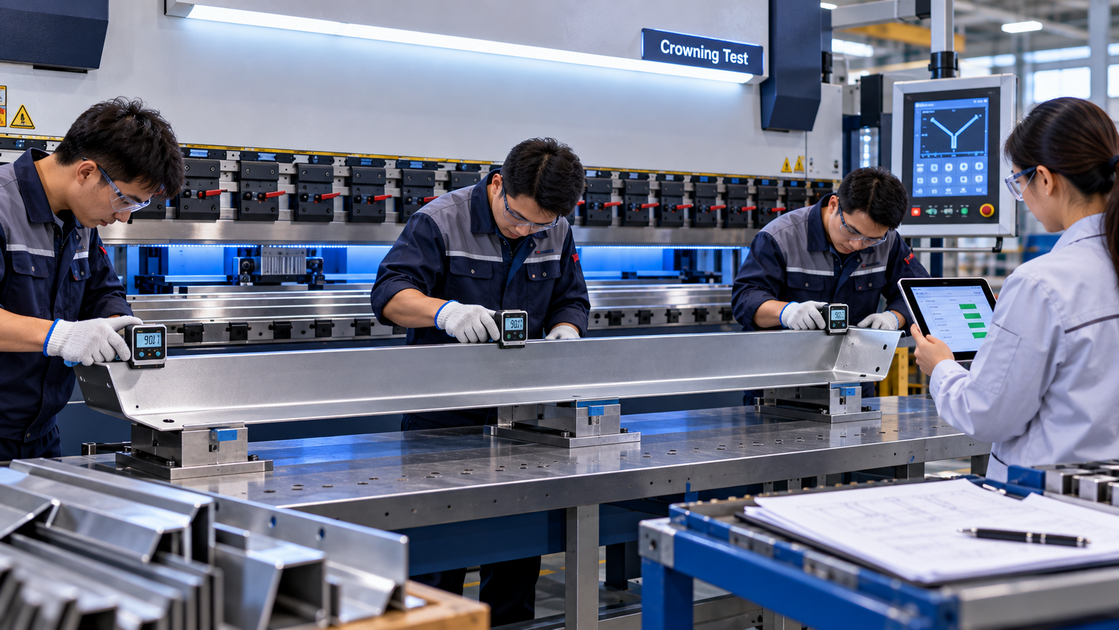
Hydraulic machines are widely available in longer-bed configurations and can be linked in tandem for exceptionally long components. However, long-bed capability alone is not enough. Buyers should ask for a real full-length crowning test using representative material.
For many small and medium-sized fabrication shops, a hydraulic machine provides a lower initial capital cost for a given tonnage and bending length. This can be a rational choice when:
- Annual machine utilisation is moderate
- Electricity cost is not the main operating expense
- The part mix includes thick materials
- Local hydraulic-service technicians are readily available
- The buyer needs broad tooling compatibility
- The business expects to expand capacity later
A lower purchase price does not always mean lower lifetime cost, but it can be appropriate when the machine will not run enough hours for energy savings to offset an electric model's price premium.
Servo-electric press brakes are often most compelling for fabricators producing repeatable, thinner-to-medium-gauge components in high volumes.
Electric press brakes can be a strong fit for:
- Electrical enclosures
- HVAC components
- Appliance panels
- Electronics cabinets
- Precision brackets
- Furniture hardware
- Light industrial cabinets
- Repetitive OEM sheet-metal components
Because servo-electric machines can provide rapid, directly controlled ram movement, they are often well suited to short-cycle, repeat work. The business case becomes stronger when operators make many bends per shift and idle energy would otherwise accumulate.
The central efficiency advantage of servo-electric design is that the drive is typically active mainly during movement rather than keeping a conventional hydraulic pump running continuously. Industry sources describe lower energy use, reduced heat generation, and lower hydraulic-maintenance exposure for servo-electric press brakes, although exact savings depend on machine size, part mix, idle time, and duty cycle.
A vendor's claimed energy-saving percentage should be treated as a hypothesis to verify—not a guaranteed result.
Ask for:
- Installed power in kW
- Average measured kWh per hour or per representative cycle
- Idle-energy consumption
- Energy use during ram approach, bending, dwell, and return
- Test material and tooling used for the measurement
- Production cycle count per shift
- Regenerative-energy details, if claimed
Servo-electric machines eliminate the conventional hydraulic main drive, which can reduce oil-related housekeeping and the risk of hydraulic leakage. This may matter for clean manufacturing environments, electronic-enclosure production, high-visibility customer facilities, or plants pursuing internal environmental objectives.
However, electric press brakes still require planned maintenance. Mechanical-drive components, lubrication, alignment, servo drives, electrical systems, and software all need inspection and service.
Many comparison articles state that electric press brakes are "limited to 300 tons," while hydraulic machines are for heavier work. That can be directionally useful but is too simplistic for a serious buying decision.
Electric press brake capability varies by manufacturer, drive architecture, bed length, stroke, daylight, safety configuration, tooling, and market availability. Hydraulic machines also vary substantially in actual usable tonnage and rigidity.
Instead of relying on a general threshold, request a supplier calculation using:
Material type+tensile strength+thickness+bend length+die opening+bending method
Then ask the supplier to demonstrate that calculation with a factory acceptance test.
A 100-ton machine bending a short mild-steel part is not comparable to a 100-ton machine bending a long high-strength steel component. The rated tonnage must be interpreted in the context of the specific job.
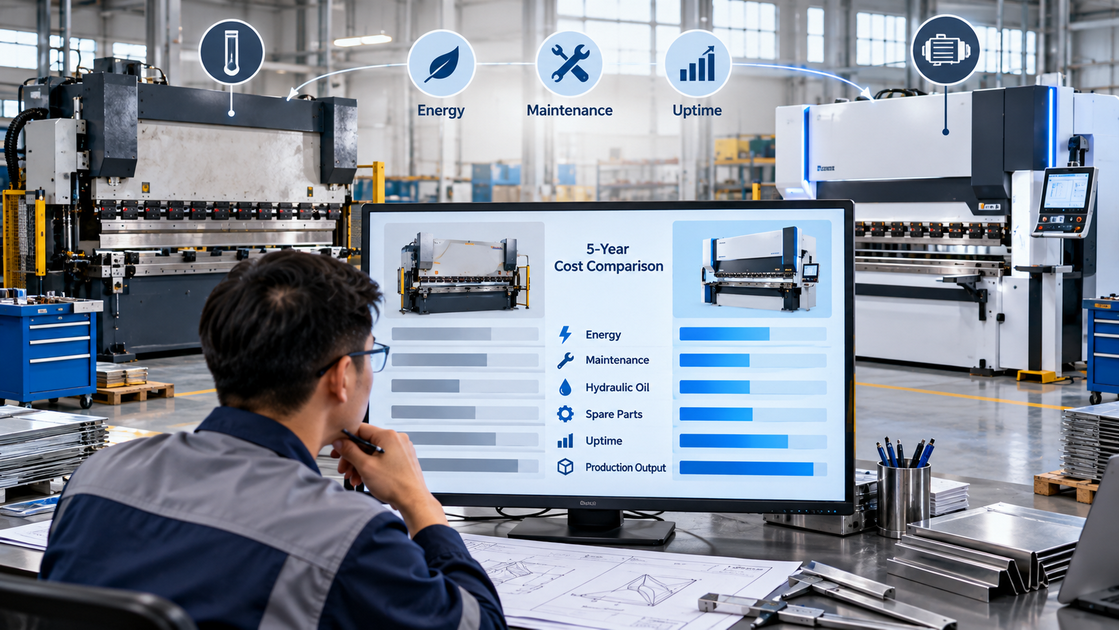
The purchase price is only one cost component. A more useful decision model compares estimated ownership cost over five years.
| Cost Category | Hydraulic Press Brake | Servo-Electric Press Brake | Buyer Calculation Method |
|---|---|---|---|
| Machine purchase | Often lower | Often higher | Compare fully configured machine prices |
| Electricity | Potentially higher at idle and under multi-shift work | Often lower in stop-start production | kWh per year × local electricity rate |
| Hydraulic oil and filters | Recurring | Usually not required for the main drive | Supplier maintenance schedule |
| Seals, hoses, valves | Potential repair expense | Not applicable to main drive | Review recommended spare-parts list |
| Mechanical drive service | Lower emphasis | Belts, screws, gears, lubrication, alignment | Review drive-system service plan |
| Cooling and heat management | May be necessary in demanding cycles | Usually lower heat load | Confirm ambient-temperature requirements |
| Downtime risk | Depends on hydraulic maintenance and part availability | Depends on servo and mechanical-drive support | Review local service response and spares |
| Resale value | Market-dependent | Market-dependent | Consider regional demand and machine age |
Use your own operating data:
Annual energy cost=Average kW demand×annual operating hours×electricity price per kWh
Then compare the estimated annual energy-cost difference with the electric machine's purchase-price premium.
For example, if an electric press brake reduces average energy demand by 6 kW during 2,000 operating hours per year and electricity costs $0.15 per kWh, the estimated annual energy saving is:
6×2,000×0.15=$1,800
If the purchase-price premium is $18,000, an energy-only payback estimate would be:
18,000÷1,800=10 years
That calculation excludes possible savings in maintenance, cooling, oil, downtime, scrap reduction, and productivity. It also illustrates why an electric press brake may be highly attractive for multi-shift, high-cycle work but less compelling for a low-utilisation job shop.
It is misleading to state that electric machines are automatically accurate and hydraulic machines are inherently imprecise. Both can achieve strong results when properly engineered and operated.
- Frame rigidity and bed straightness
- Ram synchronisation
- Linear encoders or position-feedback system
- Backgauge repeatability
- CNC crowning calibration
- Tooling condition and clamping
- Die opening and punch radius
- Material thickness variation
- Material tensile-strength variation
- Grain direction
- Springback
- Operator setup and program selection
- Temperature and machine warm-up conditions
For a hydraulic CNC press brake, electro-hydraulic synchronisation, high-quality linear scales, and properly calibrated crowning can provide excellent repeatability. For an electric press brake, direct servo control can reduce certain variables, but it cannot eliminate material springback or compensate automatically for poorly selected tooling.
Ask suppliers for a part-specific test, not a generic accuracy claim.
Press-brake safety must be part of machine selection—not an aftermarket add-on.
OSHA notes that powered press-brake safeguarding may use methods such as presence-sensing devices and two-hand controls, while power-transmission components should be enclosed. OSHA's press-brake guidance also emphasizes that guarding must protect workers from hazardous machine energy.
For buyers exporting into Europe or operating in markets that require CE compliance, ask for:
- CE Declaration of Conformity for the exact machine
- Risk assessment
- Electrical schematic
- Hydraulic schematic for hydraulic machines
- Safety-circuit documentation
- Emergency-stop circuit details
- Guarding configuration
- Light curtain, laser AOPD, or other point-of-operation safeguarding details
- Rear and side guarding
- Installation, operation, maintenance, and lockout instructions
- Applicable standards identified by the manufacturer
The EN ISO 16092 series covers safety requirements for presses; Part 1 addresses common press-safety requirements, while the series includes machine-type-specific parts.
Hydraulic presses can retain stored hydraulic pressure in cylinders or accumulators after the electrical power is switched off. A sound lockout/tagout procedure must address electrical energy, hydraulic energy, pneumatic energy where applicable, and gravity from the ram.
Electric machines also require lockout procedures for electrical energy and stored mechanical or gravitational hazards. The drive type changes the hazard profile; it does not eliminate the need for documented safety procedures.
Use this simplified framework before requesting formal quotations:
| Your Operating Condition | Likely Starting Point | Why |
|---|---|---|
| Thick plate, high tensile strength, long bends | Hydraulic CNC press brake | Broad high-tonnage and long-bed capability |
| Long workpieces requiring tandem configuration | Hydraulic CNC press brake | Commonly available tandem and high-force platforms |
| High-volume thin-sheet enclosures | Servo-electric press brake | Potential speed, repeatability, and idle-energy advantages |
| One-shift job shop with varied low-volume work | Hydraulic CNC press brake | Lower capital cost and broad flexibility may be more important |
| Multi-shift OEM repetitive production | Servo-electric press brake | Energy and cycle-time economics can become more compelling |
| Strict clean-shop or oil-management targets | Servo-electric press brake | Avoids conventional hydraulic main-drive oil system |
| Wide and unpredictable material range | Hydraulic CNC press brake | Stronger versatility for changing applications |
| Mixed production with heavy and light parts | Evaluate a two-machine strategy | A hydraulic machine plus an electric machine may optimize total workflow |
A common mistake is to compare nameplate motor power rather than actual energy consumption over a production shift.
A hydraulic machine may have a high installed motor rating but low average power in a lightly used shift. An electric machine may be very efficient during idle periods but provide less economic advantage if it operates continuously under heavy load. The only meaningful comparison is a measured duty-cycle profile.
Before buying, create a representative one-hour production scenario:
1. List the parts produced in a typical hour.
2. Record bends per part and total bends per hour.
3. Define material, thickness, bend length, and tooling.
4. Measure or request measured approach, bending, dwell, return, setup, and idle time.
5. Ask each supplier to estimate or demonstrate kWh for the same scenario.
6. Include compressor, cooling, and auxiliary equipment where relevant.
7. Convert the annual difference into cost using your local electricity tariff.
This approach produces a more credible ROI model than a generic statement that an electric machine "uses 50% less energy."
CNDY-Press, operated by Maanshan Deyan Precision Machinery Technology Co., Ltd., develops and manufactures sheet-metal processing equipment including CNC press brakes, fiber laser cutting machines, CNC shearing machines, plate rolling machines, and CNC grooving machines. The company also states that it supports long-term OEM, ODM, and customized manufacturing projects based on customer requirements.
For buyers evaluating a press brake supplier, CNDY-Press can be considered for projects requiring:
- Custom bending length, tonnage, throat depth, daylight, or stroke
- Controller and backgauge configuration discussions
- OEM branding and distributor-focused equipment programs
- Complementary sheet-metal equipment, including cutting, shearing, rolling, and grooving
- Factory-based technical communication
- Operator training and equipment-maintenance support
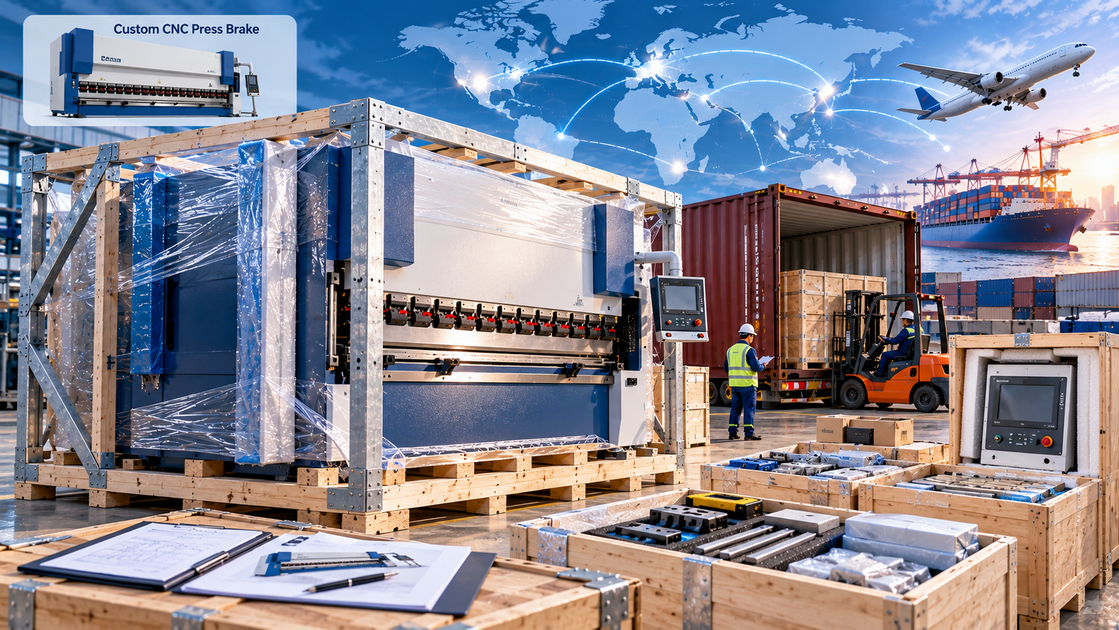
- Project-specific packaging and international delivery planning
The right configuration should be determined from the buyer's parts and process data. A supplier should not recommend an electric or hydraulic press brake until it understands the material grades, thicknesses, bend lengths, annual production pattern, accuracy target, tooling, facility power, and service expectations.
A hydraulic press brake remains the logical choice for many heavy-duty fabrication applications. It offers broad tonnage availability, long-bed options, mature service knowledge, and practical flexibility for thick, large, or changing workpieces.
A servo-electric press brake can create a strong operational advantage when a shop runs repeatable thinner-gauge parts at high cycle counts and places a high value on lower idle energy, quieter operation, reduced oil management, and controlled repeatability.
The best decision is based on your complete operating profile—not marketing claims, a single advertised tonnage, or the lowest initial quote.
No. Servo-electric machines can offer strong control and repeatability, but final bending accuracy also depends on frame rigidity, encoder feedback, crowning, tooling, material variation, and program setup. A well-configured electro-hydraulic CNC press brake can also deliver excellent accuracy.
Yes. Hydraulic CNC press brakes remain widely used for heavy-gauge materials, long parts, high-tonnage work, broad job-shop applications, and tandem systems. Modern hydraulic machines can include CNC controls, multi-axis backgauges, linear encoders, CNC crowning, and advanced safety systems.
Compare machine-price difference, measured or estimated kWh per production hour, annual operating hours, local electricity cost, preventive-maintenance cost, oil and filter cost, downtime risk, cooling requirements, and productivity differences. Use your real duty cycle rather than a supplier's generic savings percentage.
Send part drawings, material grade, tensile strength, thickness range, maximum bend length, inside bend radius, desired bend-angle tolerance, annual volume, bending method, tooling needs, controller preference, power supply, safety requirements, destination country, and desired delivery date.
Request the CE Declaration of Conformity, risk assessment, electrical and hydraulic schematics where relevant, safety-circuit information, guarding description, emergency-stop details, machine manual, maintenance instructions, and documents identifying the applicable standards. Confirm that the documents match the exact machine model and serial number.
1. [Hydraulic vs Electric Press Brake: Which One to Choose? — SENFENG USA] — Source article reviewed for its comparison of hydraulic and electric press-brake design, maintenance, energy use, and application fit. [senfenglaserusa]
2. [CNDY-Press About Us — Maanshan Deyan Precision Machinery Technology Co., Ltd.] — Company information on CNC press brakes, complete sheet-metal equipment, OEM/ODM manufacturing, custom production, operation training, and maintenance support. [cndypress]
3. [OSHA eTool: Powered Press Brakes] — OSHA safeguarding overview for powered press brakes, including presence-sensing and two-hand-control concepts. [osha]
4. [OSHA: Guidelines for Point of Operation Guarding of Power Press Brakes] — OSHA guidance on press-brake guarding and hazardous-energy protection. [osha]
5. [ISO 16092-1: Machine Tools Safety — Presses] — ISO entry for common safety requirements in the ISO 16092 press-safety standard series. [iso]
6. [Pilz: EN ISO 16092 Press Safety Standard Series] — Overview of the EN ISO 16092 standard-series structure for press safety. [pilz]
7. [Automec: Servo Electric Press Brakes vs Hydraulic] — Industry source explaining power use during motion, heat generation, maintenance, and total cost considerations. [automec]
8. [ACCURL: How Does a Servo-Electric Press Brake Work?] — Manufacturer explanation of servo-electric press-brake operation and energy-use principles. [accurl]
9. [The Fabricator: Safeguarding Press Brakes Without Sacrificing Productivity] — Industry discussion of safeguarding, safe speed, and ANSI press-brake safety concepts. [thefabricator]


